

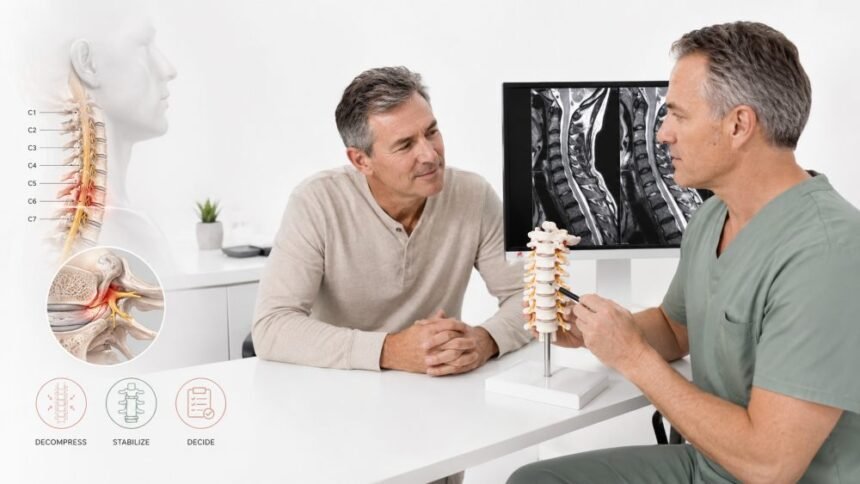
Almost nobody arrives at a spine consultation expecting the word “surgery.” People come in because their arm has ached for three months, or because they have started dropping mugs, or because there is no longer a sleeping position that gets them through the night. Then an MRI report shows up, full of phrases like foraminal narrowing and cord signal change, and suddenly there is a decision to make about the most delicate stretch of the spine there is.
Cervical spine surgery is not a single operation. It is a family of procedures performed on the seven vertebrae in your neck, and they all do some combination of two things: take pressure off a compressed nerve or spinal cord, and stabilize a segment that is no longer holding its position. Where the incision goes, what hardware is used, how long recovery takes, all of it follows from which of those two jobs your neck actually needs done. Understanding that logic is the difference between agreeing to a plan and choosing one.
Your Symptoms Carry More Weight Than Your Scan
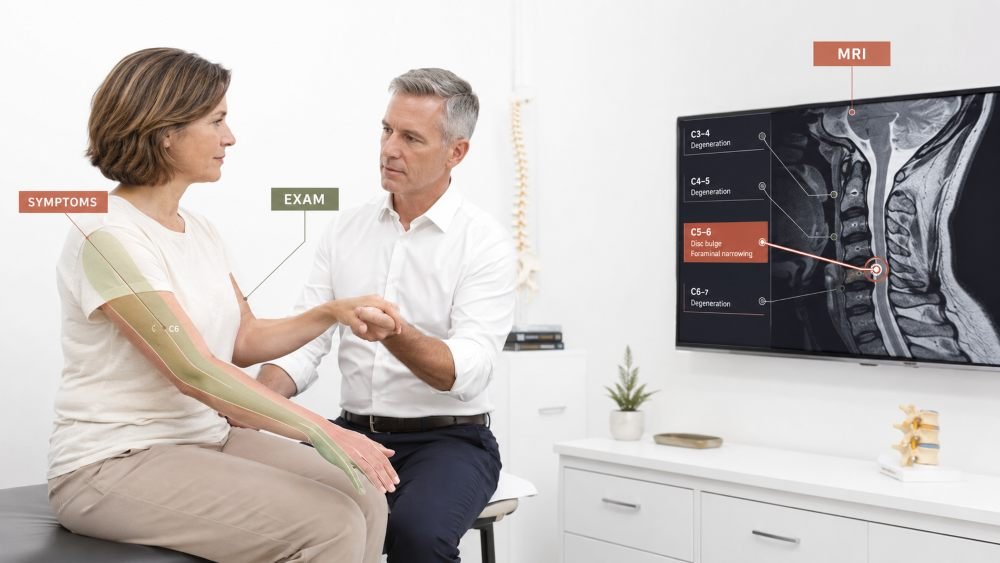
Wear and tear in the neck is close to universal past middle age. Plenty of people have visibly degenerated discs and bone spurs on imaging and no symptoms whatsoever, which is why a worrying-looking scan is not by itself a reason to operate. Mayo Clinic’s overview of cervical spondylosis makes this point plainly: the changes are expected with age, and most people who have them never notice.
What makes an operation sensible is correlation. If the MRI shows compression at one level and your numbness follows exactly the nerve path that level supplies, the story holds together. If the scan shows changes at four levels and your pain does not match any of them, an operation is a gamble dressed up as a plan. A good consultation should end with you able to say, in your own words, which structure is causing which symptom. If you cannot, that is worth saying out loud before anything gets scheduled.
Three Different Problems Share One Label
“Neck surgery” gets used as a single category, but surgeons are usually looking at one of three distinct situations, and the reasoning is different for each.
- Radiculopathy is a compressed nerve root. It typically produces pain, tingling, or weakness that travels down the arm in a recognizable pattern, sometimes with the neck itself feeling relatively fine. This is the situation where decompression surgery is most reliable, because there is a clear target and a clear symptom to relieve.
- Myelopathy is pressure on the spinal cord itself, and it behaves nothing like a pinched nerve. It is often painless. What people notice instead is that handwriting has gotten worse, buttons and zippers have become fiddly, and their walking feels less certain than it used to. The AAOS guidance on spinal cord compression in the neck notes how vague these symptoms can seem, which is exactly why they get dismissed for months.
- Axial neck pain is pain that stays in the neck with no nerve involvement. It is the most common complaint and the least predictable to treat surgically. If this is your main problem, be especially careful about how confidently anyone promises relief.
Some Symptoms Should Not Wait Their Turn
Most neck problems allow time for a considered decision. A few do not.
Sudden numbness or weakness, and any loss of bladder or bowel control, warrant same-day medical attention rather than an appointment next week. Progressive clumsiness in the hands, worsening balance, or a change in how you walk should prompt evaluation even when nothing hurts, because these point toward cord involvement.
This distinction matters for a reason people are rarely told directly. In myelopathy, surgery is often aimed at halting decline rather than reversing it. Decompression relieves pressure so the cord stops being squeezed, but function that has already been lost may return only partly, and slowly. That reality changes the calculation. Waiting to see whether a pinched nerve settles down is reasonable. Waiting to see whether cord compression gets worse usually is not.
What A Fair Trial Of Non-Surgical Care Actually Involves
Most people with a compressed cervical nerve get better without an operation. The evidence on nonoperative management is reassuring on this point, and it also notes that imaging is not needed early on unless there has been trauma, symptoms persist, or red flags are present. Substantial improvement often shows up within the first several weeks, with recovery continuing over four to six months.
But there is a difference between conservative treatment and simply waiting. A genuine trial usually includes structured physical therapy that involves strengthening and stretching rather than passive heat and massage alone, plus anti-inflammatory medications where they are appropriate for you. A soft collar can help briefly but weakens neck muscles if worn too long. Epidural steroid injections may buy meaningful short-term relief. They can help confirm which level is responsible, though they carry small but serious risks that deserve a real conversation rather than a signature.
What does not count as a fair trial: six months of avoiding activity, or an open-ended opioid prescription with no rehabilitation attached. If a surgeon says conservative care has failed, it is fair to ask which specific treatments were tried and for how long.
Named Procedures And What Each One Trades
Anterior cervical discectomy and fusion, or ACDF, is the operation most people encounter first. The surgeon works through the front of the neck, removes the damaged disc, and places a spacer, often with a small plate, so the two vertebrae grow together. Cleveland Clinic’s patient guide to ACDF surgery describes the trade honestly: you give up a small amount of movement at that level in exchange for decompression and stability. Because it is the best established of these procedures, ACDF tends to dominate the results when people start researching cervical spine surgery in New Jersey or anywhere else, which can make it look like the only option. It is not.
Cervical disc replacement uses an artificial disc instead of a fusion, preserving motion at that level and putting less stress on neighboring segments. As Johns Hopkins notes in its overview of cervical disc replacement surgery, the appeal is real, but candidacy is narrower. It generally requires adequate remaining disc height, reasonably healthy facet joints, and no significant instability or deformity. If you are told you are not a candidate, ask which specific finding rules it out.
A posterior foraminotomy approaches from the back of the neck and enlarges the opening the nerve exits through, without fusing anything. It suits a specific pattern of compression and is worth asking about if your problem is a single nerve root pinched off to one side.
Laminoplasty and laminectomy with fusion are used when the cord is compressed across several levels, usually in myelopathy. AAOS covers the reasoning behind these surgical options for cord compression in more depth. The AAOS summary of surgical options for a pinched nerve is a useful companion piece if radiculopathy is your situation.
The single variable that changes recovery most is not which approach is used but how many levels are involved. One level and three levels are genuinely different operations with different timelines and different long-term motion.
Questions That Change The Conversation
Consultations go better when the questions are specific. These are worth writing down:
- Which of my symptoms is this operation aimed at, and which ones will it probably not touch?
- How many levels, and what would have to be true for you to do fewer?
- Am I a candidate for a motion-preserving option, and if not, what exactly rules it out?
- If I wait three more months, what is the realistic worst case?
- How often do you perform this specific procedure, and what does your reoperation rate look like?
- Who do I call on a Saturday night in week two if something feels wrong?
That last one sounds trivial and is the question people most often wish they had asked.
Recovery: The Parts People Are Least Prepared For
Arm pain frequently improves fast, sometimes immediately. Neck stiffness, muscle fatigue, and a general sense of being wiped out tend to last longer and surprise people who were braced for pain instead.
After front-of-the-neck approaches, a sore throat and some difficulty swallowing are common in the early weeks and usually settle. Temporary hoarseness happens less often. Both are worth knowing about in advance so they do not feel like something has gone wrong.
Fusion is a biological process that unfolds over months, not something completed in the operating room. That is why lifting restrictions and driving limits exist well after you feel fine, and why physical therapy typically starts a few weeks in rather than immediately.
Smoking deserves a direct mention here, with more nuance than it usually gets. A review of smoking and spinal fusion outcomes found that single-level ACDF fusion rates in smokers were broadly similar to non-smokers in several studies. Still, multilevel anterior procedures showed lower fusion rates meaningfully, alongside higher infection risk, more severe swallowing problems, and increased odds of needing further surgery at adjacent levels later. The first four weeks after surgery are the period that matters most for bone healing. If you are going to quit for any window at all, that is the one.
Practical preparation is undervalued. Move everyday items to chest height so you are not reaching overhead or bending down, stock the fridge before you go in, arrange rides for the first couple of weeks, and think through how you will manage showering and washing your hair with a collar on.
What Surgery Reliably Delivers, And What It Does Not
Relieving nerve compression is what these operations do well. Arm pain, in particular, responds better than most people expect.
What surgery is less good at: erasing years of accumulated neck stiffness, eliminating aches that come with weather or fatigue, or restoring sensation in an area that has been numb for a long time. Nerves that have been compressed for months recover unevenly, and some numbness may persist even when the pressure is gone. Over the following years, the levels next to a fusion carry more load and can develop their own problems, which is part of why level count and motion preservation get so much attention.
None of this is an argument against surgery. It is an argument for knowing which line on your list of complaints is likely to change, so that success feels like success when it arrives.
Deciding Without Feeling Rushed
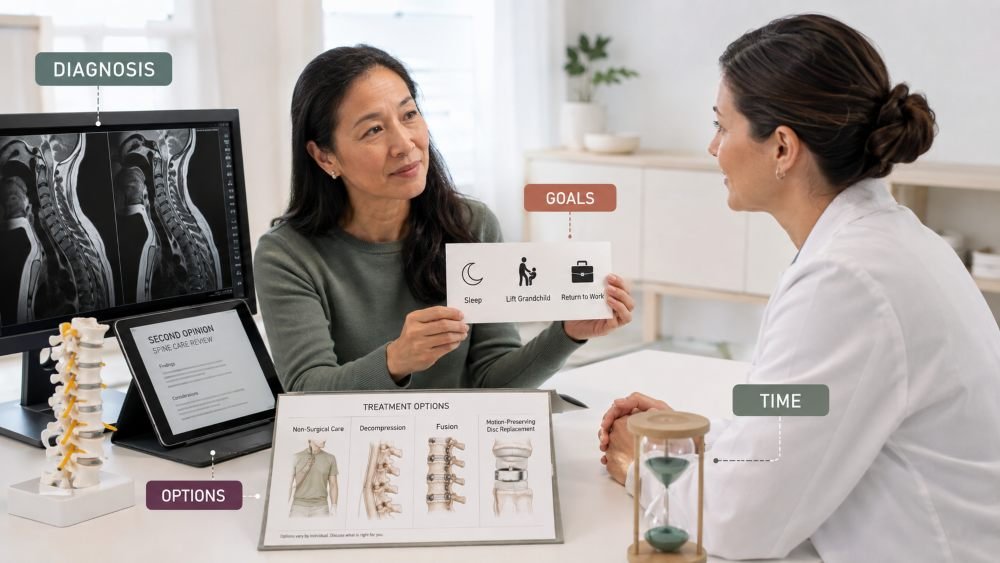
Second opinions are ordinary in spine care and no reasonable surgeon takes offense at one. When you get one, bring the actual imaging files rather than only the written report, because the interpretation is often where opinions diverge.
Before you go, write down the three things you most want to get back to doing, whether that is sleeping through the night, lifting a grandchild, or working a full day without your arm going dead. Those goals are more useful in the conversation than a pain score, because they tell a surgeon what a good outcome would actually look like for you.
The right decision is not always the one that includes an operation, and it is not always the one that avoids it. It is the one made with a clear diagnosis, a fair attempt at less invasive care, honest expectations about what will and will not change, and enough time to think it through.
This article is for general information and is not a substitute for professional medical advice, diagnosis, or treatment. Always consult a qualified healthcare provider about your own symptoms and treatment options. Seek immediate medical attention for sudden weakness, sudden numbness, or loss of bladder or bowel control.
References
- Mayo Clinic. Cervical spondylosis: Symptoms and causes. Mayo Foundation for Medical Education and Research. https://www.mayoclinic.org/diseases-conditions/cervical-spondylosis/symptoms-causes/syc-20370787
- American Academy of Orthopaedic Surgeons. Cervical Spinal Cord Compression (Cervical Spondylotic Myelopathy). OrthoInfo. https://orthoinfo.aaos.org/en/diseases–conditions/cervical-spondylotic-myelopathy-spinal-cord-compression/
- American Academy of Orthopaedic Surgeons. Cervical Spondylotic Myelopathy: Surgical Treatment Options. OrthoInfo. https://orthoinfo.aaos.org/en/treatment/cervical-spondylotic-myelopathysurgical-treatment-options/
- Childress MA, Becker BA. Nonoperative Management of Cervical Radiculopathy. American Family Physician. 2016;93(9):746-754. PMID: 27175952. https://pubmed.ncbi.nlm.nih.gov/27175952/
- American Academy of Orthopaedic Surgeons. Cervical Radiculopathy: Surgical Treatment Options. OrthoInfo. https://orthoinfo.aaos.org/en/treatment/cervical-radiculopathy-surgical-treatment-options/
- Cleveland Clinic. ACDF (Anterior Cervical Discectomy and Fusion) Surgery. https://my.clevelandclinic.org/health/procedures/acdf-surgery
- Johns Hopkins Medicine. Cervical Disk Replacement Surgery. Health Library. https://www.hopkinsmedicine.org/health/treatment-tests-and-therapies/cervical-disk-replacement-surgery
- Berman D, Oren JH, Bendo J, Spivak J. The Effect of Smoking on Spinal Fusion. International Journal of Spine Surgery. 2017;11(4):29. doi:10.14444/4029. https://www.ijssurgery.com/content/11/4/29