

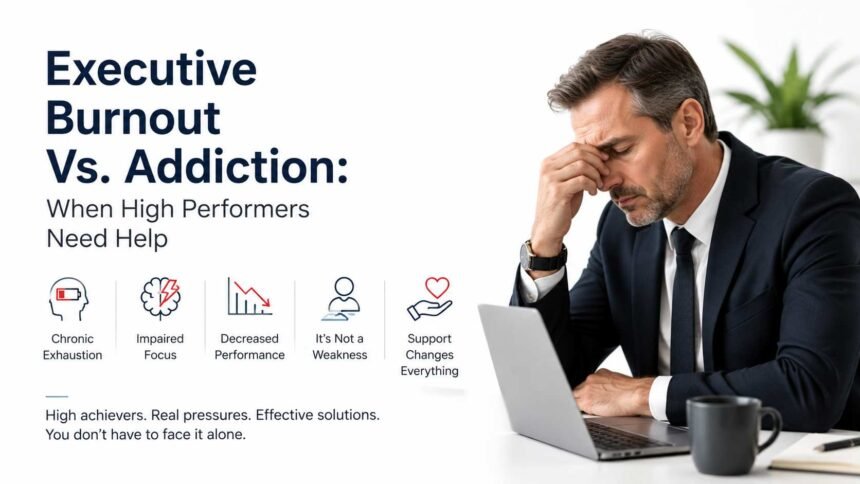
High performers are often praised for pushing through. They work longer hours, carry more pressure, and keep producing even when the cost is obvious to everyone around them. From the outside, that can look like discipline. Sometimes it is. Sometimes it is burnout. And sometimes it is something more serious that has started to hide inside a successful life.
That distinction matters. Executive burnout and addiction can overlap in ways that are easy to miss, especially when someone is still meeting deadlines, leading teams, and showing up polished. A person can be deeply unwell and still look impressive on paper. By the time the problem becomes impossible to ignore, relationships may be strained, health may be declining, and substance use may already be serving a much bigger role than stress relief.
Knowing the difference is not about labeling someone too quickly. It is about recognizing when ordinary recovery strategies are no longer enough.
What Executive Burnout Actually Looks Like

Burnout is not simply being tired after a demanding quarter. It is a state of physical, emotional, and mental depletion caused by prolonged stress without adequate recovery. For executives and other high achievers, it often builds slowly. The person adapts, compensates, and keeps going, which can make the problem harder to spot.
Common signs of burnout include:
- Persistent exhaustion that rest does not fully relieve
- Cynicism, detachment, or irritability at work and at home
- Trouble concentrating or making decisions
- Loss of motivation, even in areas that once felt meaningful
- Sleep disruption, headaches, digestive issues, or frequent illness
Burnout can make people feel flat, numb, and increasingly disconnected from themselves. They may still function at a high level, but it takes more effort to do what once felt routine. Many describe it as running on fumes while trying to look composed.
Where Addiction Enters The Picture
Addiction involves compulsive use of a substance despite negative consequences. It changes behavior, priorities, and often brain function over time. For high performers, the early stages may not look dramatic. A few drinks to shut off after work. Prescription stimulants to stay sharp. Sleep medication to force rest. Cocaine at networking events. More alcohol on flights, in hotel bars, or alone late at night.
The issue is not only how much someone uses. It is the role the substance plays. If it becomes the main way a person regulates stress, boosts confidence, manages anxiety, sleeps, or keeps performing, the risk rises quickly.
Addiction also tends to protect itself. A successful person may tell themselves they cannot have a problem because they are still closing deals, leading meetings, or supporting a family. Functioning is not the same as being healthy.
Why The Two Are So Often Confused
Burnout and addiction share several warning signs: irritability, sleep problems, isolation, reduced focus, and emotional volatility. Both can lead to missed commitments, strained relationships, and a growing sense that life is becoming harder to manage.
There is another complication. Burnout can feed substance use, and substance use can deepen burnout. Someone who is depleted may drink more to come down at night. That alcohol then disrupts sleep, worsens anxiety, and leaves them less resilient the next day. A stimulant may help them power through fatigue, but it can also increase agitation, dependence, and the crash that follows.
What starts as self-medication can become a cycle that no amount of productivity hacks will fix.
Signs It May Be More Than Burnout
If a high performer is wondering whether they are burned out or dealing with addiction, a few questions can help clarify what is happening.
- Is substance use increasing in frequency or amount?
- Are there failed attempts to cut back?
- Does work performance depend on using something to get up, calm down, or sleep?
- Are there blackouts, secrecy, hiding, or minimizing?
- Have loved ones expressed concern more than once?
- Is the person using despite health, legal, financial, or relationship consequences?
Burnout can be serious on its own. But when substances become central to coping, or when stopping feels threatening rather than inconvenient, it is time to look beyond stress management and consider clinical support.
Why High Achievers Wait Too Long To Get Help
Executives are often rewarded for control, decisiveness, and endurance. Those traits can become barriers in private life. Asking for help may feel like weakness. Slowing down may feel irresponsible. Some fear professional fallout if they admit they are struggling. Others compare themselves to stereotypes of addiction and decide they do not qualify.
That delay can be costly. The longer someone relies on substances to keep functioning, the more difficult it becomes to separate identity from performance and performance from chemical support. What looks like resilience from the outside may actually be a very fragile system held together by adrenaline, secrecy, and habit.
What Effective Help Can Look Like

High performers often need treatment that addresses both the visible problem and the underlying drivers. That may include anxiety, depression, trauma, chronic stress, perfectionism, or a complete collapse of boundaries between work and self-worth. If only the substance use is addressed, the person may return to the same pressure system that fueled the problem.
A strong executive rehab program typically combines addiction treatment with mental health care, privacy, and individualized planning. Evidence-based therapies such as cognitive behavioral therapy and dialectical behavior therapy can help people understand triggers, challenge distorted thinking, and build healthier responses to stress. Medical and psychiatric support may also be necessary, especially when alcohol, benzodiazepines, stimulants, or co-occurring conditions are involved.
Just as important, treatment should make room for the reality of executive life without glorifying it. The goal is not to get someone back to overfunctioning as fast as possible. It is to help them recover in a way that is stable, honest, and sustainable.
When Stepping Away Is The Smartest Move In The Room
Many high achievers believe they can solve this alone if they just become more disciplined. But burnout and addiction both distort judgment. The person inside the problem is often the last one to see its full shape.
Getting help is not an admission that someone is incapable. It is a recognition that capacity has limits and that pushing past those limits has consequences. For some, the right next step is rest, therapy, and a real reduction in workload. For others, it is a structured treatment setting where substance use and mental health can be addressed together before more damage is done.
There is nothing admirable about waiting until a crisis forces the issue. The stronger move is noticing the pattern early, telling the truth about it, and choosing support while there is still plenty of life, work, and self-respect left to protect.
Disclaimer
The content provided in “Executive Burnout Vs. Addiction: When High Performers Need Help” is for informational and educational purposes only and should not be considered medical, psychological, or clinical advice. It is not intended to diagnose, treat, or replace consultation with a qualified healthcare professional.
Burnout, substance use, and addiction are complex medical and psychological conditions that require individualized assessment. If you or someone you know is experiencing symptoms described in this article, it is important to seek support from a licensed physician, psychologist, psychiatrist, or addiction specialist.
In cases of severe distress, substance dependence, or risk of harm, please get in touch with local emergency services or a certified mental health crisis line immediately.
References
- Maslach, C., & Leiter, M. P. (2016). Understanding the burnout experience: Recent research and its implications for psychiatry. Annual Review of Psychology, 67, 39–60.
- Volkow, N. D., Koob, G. F., & McLellan, A. T. (2016). Neurobiologic Advances from the Brain Disease Model of Addiction. New England Journal of Medicine, 374(4), 363–371.
- World Health Organization. (2019). Burn-out an “occupational phenomenon”: International Classification of Diseases 11th Revision (ICD-11).
- National Institute for Health and Care Excellence (NICE). (2022). Alcohol-use disorders: diagnosis, assessment and management of harmful drinking and alcohol dependence.
- American Psychiatric Association. (2022). Diagnostic and Statistical Manual of Mental Disorders (DSM-5-TR).