

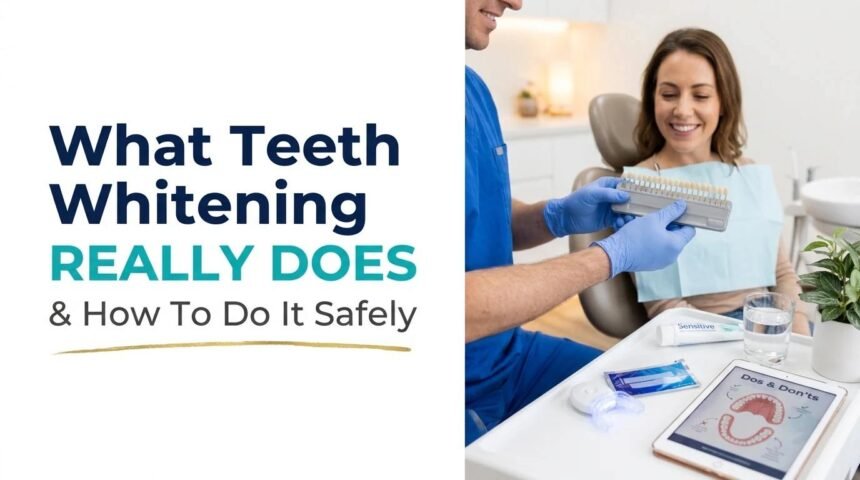
For most people, the idea of whitening starts with a photo. You see yourself laughing at a wedding or a birthday dinner, and your teeth look a shade or two darker than you remember. Then you walk into a pharmacy and face a wall of strips, pens, LED mouthpieces and charcoal powders, all promising a brighter smile by next week.
The reassuring part is that whitening is one of the better-studied cosmetic treatments in dentistry. Peroxide products really do change tooth color, and for most healthy adults the side effects are mild and brief. The catch is that your result depends far more on why your teeth are dark, and on the health of your mouth, than on which box you buy. Below is what happens inside the tooth, how the options compare, who should wait, and how to avoid paying for a brighter smile with pain or lost enamel.
Why Your Teeth Changed Color Matters More Than Any Product
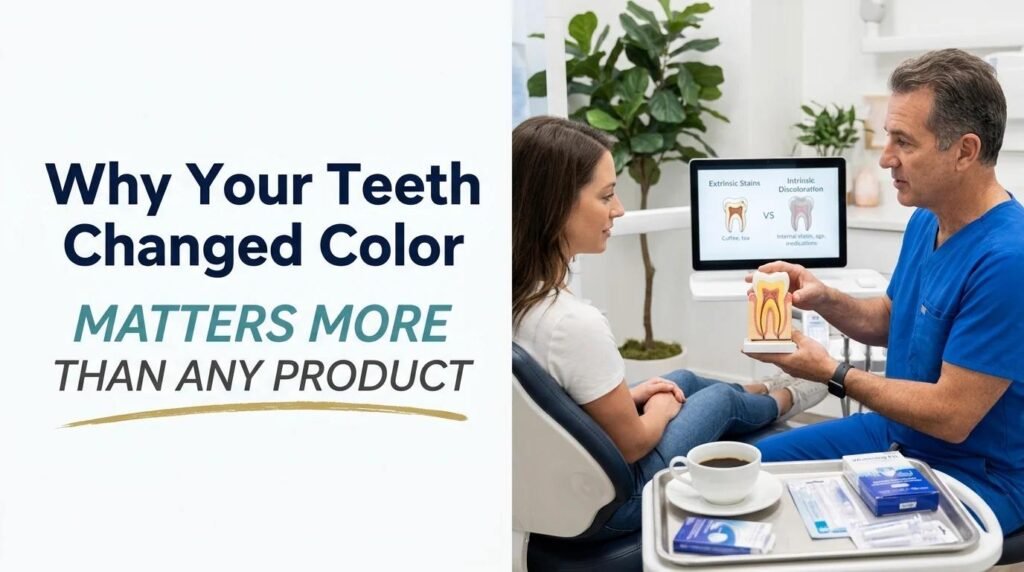
Dentists sort discoloration into two broad groups. Extrinsic stains sit on the outer surface of the enamel. They build up from coffee, tea, red wine, cola, soy sauce, berries and tobacco, and they are the stains most products handle well. Intrinsic discoloration sits deeper, inside the enamel or in the dentin underneath. It can come from a knock to a tooth years ago, certain medicines taken while the teeth were forming (tetracycline antibiotics are the classic example), too much fluoride in childhood, or inherited conditions that affect how enamel forms.
Age adds its own layer. Enamel slowly thins over the decades, so more of the naturally yellow dentin shows through. Cleveland Clinic’s guide to tooth discoloration also points out that some health conditions, chemotherapy and head and neck radiation can change tooth color, and that old silver fillings can make teeth look grayish.
As a rough guide to what tends to respond:
- Yellow or light brown teeth from food, drink and age usually lighten well.
- Brown tobacco stains lighten, but often need longer treatment and return faster if smoking continues.
- Gray or blue-gray bands from tetracycline can improve, but may need around three to four months of nightly tray use.
- White fluorosis spots and marks left after braces often show less change.
- A single tooth that has turned dark on its own is a separate problem, covered further down.
If you are not sure which group your stains fall into, that alone is worth a dental visit. It decides whether a $30 kit is enough or whether no gel will get you there.
Inside The Tooth, Peroxide Does Chemistry, Not Scrubbing
Nearly every product that truly changes tooth color relies on one of two ingredients: hydrogen peroxide or carbamide peroxide. Carbamide peroxide breaks down in the mouth and releases about a third of its strength as hydrogen peroxide. That is why a 10% carbamide peroxide gel is milder than it sounds. It works out to roughly 3.5% hydrogen peroxide.
The peroxide passes through the enamel into the dentin, where it breaks apart the large, colored molecules that make teeth look dark. Smaller molecules reflect less color, so the tooth looks lighter. Nothing is being sanded away. A review archived in the National Institutes of Health’s PubMed Central library concluded that hydrogen and carbamide peroxide whitening is safe and effective when people follow the manufacturer’s instructions, while still flagging sensitivity and gum irritation as real risks.
Whitening toothpastes are a different category. Most use polishing agents or stain-lifting chemicals rather than bleach, so they can brighten a smile that has dulled from coffee but will not change the color inside the tooth. Think of them as upkeep, not treatment.
What A Review Of 12 Clinical Trials Found About Home Versus Chair-Side Bleaching
There are three main routes, and the right one depends on your budget, your patience and how sensitive your teeth already are.
Take-home whitening kits come in two very different forms: store-bought strips and paint-on gels you apply yourself, and custom trays your dentist makes from a scan or mold of your teeth, used with a prescription carbamide peroxide gel. In-office bleaching uses a much stronger hydrogen peroxide gel, with your gums covered by a protective barrier, and usually takes one or two appointments.
| Option | Usual active ingredient | Typical time commitment | Works best for | Main drawbacks |
| Over-the-counter strips and gels | Low-strength hydrogen peroxide | Daily for one to two weeks, per the label | Mild surface yellowing in healthy teeth | One-size fit, gel can touch the gums, uneven near the edges |
| Dentist-made custom trays | Carbamide peroxide, strength set by your dentist | About 2 to 10 hours a day for one to four weeks | Most healthy adults, including older or deeper stains | Needs a dental visit first, slower than in-office |
| In-office bleaching | High-strength hydrogen peroxide | One or two visits, with gel applied in short rounds | People who want a fast change or a head start before trays | Highest cost, sensitivity can be sharper for a day or two |
In 2016, a team of researchers pooled randomized trials that compared dentist-supervised home trays with in-office bleaching in adults. After screening, 12 studies made the final review and 8 had data that could be combined. They found no meaningful difference between the two approaches, either in how much the teeth lightened or in the risk and strength of sensitivity.
So the real trade-off is time and money, not results. In-office bleaching gets you there in an afternoon. Custom trays reach a similar place more slowly, usually for less, and you keep the trays for touch-ups.
Why Researchers Question The Blue Light
Many clinics and kits feature a blue LED or laser. A 2012 meta-analysis found that when high-strength peroxide (25% to 35%) was used, adding light made no difference to how white teeth became, either right away or in the following weeks. It did, however, raise the odds of sensitivity about three and a half times. A larger 2018 review of 21 randomized trials also found that light did not improve the color change. If a price jumps because of the lamp, it is fair to ask what you are paying for.
Sensitivity Is The Side Effect Most People Notice, And It Can Be Managed
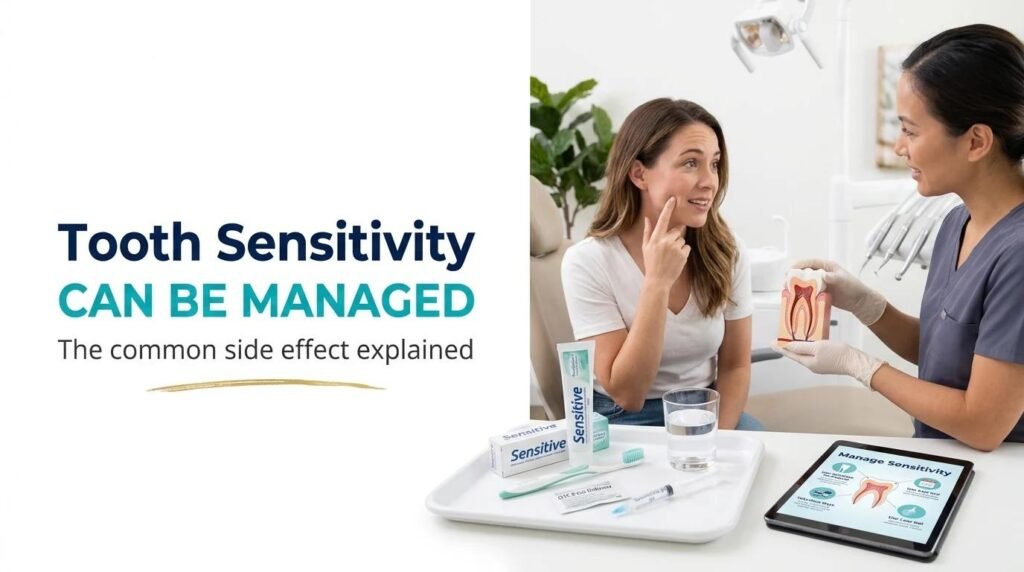
According to the American Dental Association’s clinical overview of whitening, temporary tooth sensitivity and gum inflammation are the most common side effects. Sensitivity usually shows up within the first two or three days, and with strips or trays it often eases by around the fourth day. People describe it as brief electric “zings,” a twinge with cold water, or a dull ache. It happens because the peroxide reaches the dentin and the nerve, and it fades once you pause or finish.
You can usually keep it in check:
- Switch to a sensitivity toothpaste with potassium nitrate a couple of weeks before you start, and keep using it during treatment. A 2015 meta-analysis of 10 trials found that potassium nitrate and sodium fluoride reduced bleaching sensitivity, with no consistent effect on the final color.
- Choose a lower strength worn for longer rather than a stronger gel for speed. Lower peroxide levels have been linked with less sensitivity.
- Build in rest days. Skipping a day between sessions lets the nerve settle, and the color still arrives.
- Use only a small drop of gel per tooth in trays. Overfilled or poorly fitting trays push gel onto the gums, which is the usual cause of white, sore patches.
- Before in-office treatment, ask your dentist about a desensitizing gel or taking an over-the-counter pain reliever beforehand.
One exception matters. Pain that is sharp, sits in one tooth, lasts more than a few days after you stop, or comes with swelling is not ordinary whitening sensitivity. It can point to a crack, a cavity, a leaking filling or an exposed root, and it deserves a dental check before you go any further.
Who Should Hold Off Before Whitening
Whitening is elective, so there is no medical reason to rush it. An ADA spokesperson has noted that people with cavities, active infections or receding gums can have more irritation and sensitivity from whitening. The ADA’s own guidance also starts with a dental exam and a health history, including any allergies to bleaching ingredients.
It makes sense to wait, or to see a dentist first, if any of these apply:
- Untreated cavities, cracks or thin, worn enamel. Peroxide reaches the nerve faster through a damaged tooth.
- Gum disease or exposed roots. Root surfaces have no enamel, they will not whiten, and they become sensitive quickly.
- Children and teenagers. In the European Union and the UK, products containing more than 0.1% hydrogen peroxide may not be used on anyone under 18, and the American Academy of Pediatric Dentistry discourages full-mouth cosmetic bleaching while a child still has baby teeth. Young teeth also have larger nerve chambers, so they tend to feel it more.
- Pregnancy and breastfeeding. There is very little research on whitening during pregnancy, so many dentists suggest waiting until afterward.
- A past reaction to a whitening product, or a known allergy to any of its ingredients.
Product choice matters too. The European Union limits over-the-counter whitening products to 0.1% hydrogen peroxide and keeps stronger ones, up to 6%, in dental hands, while the US sells a much wider range of strengths straight to consumers. One useful filter is the ADA Seal of Acceptance, which shows the company gave the ADA evidence of safety and effectiveness when used as directed. Products dentists dispense are not eligible for the Seal, so its absence on professional gels is not a warning sign.
Crown And Veneer Problem Nobody Puts On The Box
Whitening only works on natural tooth structure. Crowns, veneers, bonding and tooth-colored fillings stay the shade they were made in. If you have a crown on a front tooth and whiten everything around it, that crown can suddenly look darker than its neighbors.
If you are planning new work on your front teeth, whiten first and match the new restorations to your new shade. Many dentists wait a week or two after bleaching, because the shade can shift slightly and fresh bleaching can briefly weaken how well bonding materials stick.
A single tooth that has turned gray, often years after a knock, needs its own approach. The nerve inside may have died, and surface whitening rarely helps. After an X-ray, the fix may be root canal treatment followed by bleaching from inside the tooth, or a veneer or crown.
When bleaching reaches its limit, because of deep intrinsic stains, tetracycline banding, fluorosis or mismatched restorations, the next options are usually bonding, porcelain veneers or crowns. This is where careful planning matters more than any gel. For readers in Northern Virginia, a practice offering cosmetic dentistry in Sterling, VA can assess whether whitening, bonding, veneers or a mix of them makes the most sense for your teeth, and in what order.
What The Evidence Says About Charcoal, Lemons And Other Kitchen Hacks
Social media is full of free whitening tricks. Most do nothing, and some wear away enamel, which lets more yellow dentin show. An abrasive hack can leave teeth looking darker over time.
| Trend | What the evidence shows | The risk |
| Activated charcoal powders and pastes | A 2017 literature review found too little clinical and lab data to support whitening or safety claims | Abrasive, and many products contain no fluoride |
| Strawberries mashed with baking soda | A study cited by the ADA found no measurable whitening | Fruit acid on enamel and false confidence |
| Lemon juice or vinegar rubs | No reliable whitening evidence | Acid dissolves enamel, and erosion does not grow back |
| Charcoal mixed with salt | One report linked it to enamel erosion and cavities on front teeth | Lasting damage to the teeth you most want to show |
| Oil pulling | No documented whitening effect | Linked to rare harms, including lung inflammation when oil is breathed in |
The authors of that charcoal review, published in the Journal of the American Dental Association and indexed on PubMed, advised dentists to warn patients to be cautious with charcoal products making unproven claims.
A Sensible First Round, From Shade Check To Stopping Point
If you have decided to go ahead, a little planning makes the difference between a result you love and a week of sore teeth.
Start with a cleaning. The ADA’s consumer spokesperson has suggested a professional cleaning before whitening. It clears plaque so the gel reaches the enamel evenly, catches problems whitening could aggravate, and sometimes leaves teeth bright enough that people skip whitening altogether.
Record your starting shade. Take a photo in daylight with no filter, holding a sheet of white paper near your chin. Color changes gradually, and without a baseline it is easy to think nothing is working and overuse the product.
Pick one product and follow it exactly. Choose an ADA Seal product or dentist-supplied trays and stick to the stated wear time. Stacking strips, pens and an LED gadget does not stack the results. It mainly raises the chance of sensitivity and gum irritation.
Expect gradual change. Yellow tones respond best and fastest, gray tones slowly. With home products the lightening builds across the full course, so judge the result at the end, not after one session.
Know when to stop. Stop when you like the shade, when the color has stopped changing, or when sensitivity no longer settles between sessions. Every tooth has a natural limit, and going past it adds risk without adding brightness.
How To Keep Your New Shade Longer
Whitening is not permanent. Color drifts back gradually, and faster with coffee, tea, red wine and tobacco. A 2023 systematic review of at-home bleaching found results were generally stable over time, though teeth with severe discoloration were more likely to darken again.
A few habits stretch the result:
- Drink dark drinks through a straw when practical, and rinse with water afterward.
- Wait about 30 minutes after acidic food or drink before brushing, so you are not scrubbing softened enamel.
- Keep up regular cleanings, which remove new surface stains before they set in.
- Use a whitening toothpaste with the ADA Seal for upkeep, not as a replacement for bleaching.
- Plan touch-ups instead of constant use. With custom trays, a few nights once or twice a year is often enough.
- Cut down or quit tobacco, which is the single biggest factor in stains coming back.
A Healthy Mouth Comes Before A Whiter One
Whitening is a cosmetic treatment for healthy teeth, not a sign of oral health, and natural teeth were never meant to be paper white. A soft ivory shade on clean, strong teeth with healthy gums is a genuinely healthy smile.
Treat these as reasons to see a dentist promptly, whether or not you are whitening:
- Pain that does not settle within a few days of stopping a product.
- White, peeling or raw patches on the gums that have not healed within a week.
- A tooth that darkens on its own, especially after an injury.
- Swelling, a bad taste or a pimple-like bump on the gum near a tooth.
- Teeth that are changing color quickly for no clear reason, or after starting a new medicine.
The safest whitening plan begins with a check-up, not a purchase. Once you know your teeth and gums are sound and your stains are the kind that respond, choosing between strips, trays and the dental chair becomes much simpler.
Health Disclaimer
This article is for general information only and does not replace advice from a dentist or doctor who can examine you. Whitening products vary in strength and directions, so follow the label or your dentist’s instructions exactly. Stop using any product and seek dental care if you develop lasting pain, gum injury or swelling.
References
- American Dental Association. Whitening. Oral Health Topics. ADA Library. Accessed November 25, 2026. https://www.ada.org/resources/ada-library/oral-health-topics/whitening
- Brooks JK, Bashirelahi N, Reynolds MA. Charcoal and charcoal-based dentifrices: a literature review. Journal of the American Dental Association. 2017;148(9):661-670. doi:10.1016/j.adaj.2017.05.001
- Carey CM. Tooth whitening: what we now know. Journal of Evidence-Based Dental Practice. 2014;14(Suppl):70-76. doi:10.1016/j.jebdp.2014.02.006
- Cleveland Clinic. Tooth discoloration. Last reviewed July 3, 2025. https://my.clevelandclinic.org/health/diseases/10958-tooth-discoloration
- Council of the European Union. Council Directive 2011/84/EU of 20 September 2011 amending Directive 76/768/EEC, concerning cosmetic products, for the purpose of adapting Annex III thereto to technical progress. Official Journal of the European Union. 2011;L283:36-38. http://data.europa.eu/eli/dir/2011/84/oj
- de Geus JL, Wambier LM, Kossatz S, Loguercio AD, Reis A. At-home vs in-office bleaching: a systematic review and meta-analysis. Operative Dentistry. 2016;41(4):341-356. doi:10.2341/15-287-LIT
- Fioresta R, Melo M, Forner L, Sanz JL. Prognosis in home dental bleaching: a systematic review. Clinical Oral Investigations. 2023;27(7):3347-3361. doi:10.1007/s00784-023-05069-0
- He LB, Shao MY, Tan K, Xu X, Li JY. The effects of light on bleaching and tooth sensitivity during in-office vital bleaching: a systematic review and meta-analysis. Journal of Dentistry. 2012;40(8):644-653. doi:10.1016/j.jdent.2012.04.010
- Maran BM, Burey A, de Paris Matos T, Loguercio AD, Reis A. In-office dental bleaching with light vs. without light: a systematic review and meta-analysis. Journal of Dentistry. 2018;70:1-13. doi:10.1016/j.jdent.2017.11.007
- Wang Y, Gao J, Jiang T, Liang S, Zhou Y, Matis BA. Evaluation of the efficacy of potassium nitrate and sodium fluoride as desensitizing agents during tooth bleaching treatment: a systematic review and meta-analysis. Journal of Dentistry. 2015;43(8):913-923. doi:10.1016/j.jdent.2015.03.015