

Ask any woman who has sat in an emergency room clutching her skull while the clock ticks past the hour mark, and she will tell you something the research now backs up in hard numbers. Headache care in this country still runs on a double standard, and women are the ones paying for it.
The disparity is not subtle once you start looking for it. Women develop migraine at roughly three times the rate of men, with some population studies putting the lifetime gap even higher during peak reproductive years. Women also report longer attacks, more disabling symptoms, and a heavier day-to-day burden. Logic would suggest the group carrying the larger share of disease gets the faster, more thorough response from the healthcare system. Logic would be wrong.
Across emergency departments, primary care offices, and neurology referral pipelines, women wait longer, get worked up less thoroughly, and are more likely to have real physical pain filed under a psychological heading. The gap does not show up as one dramatic failure. It shows up as a hundred small ones, stacked on top of each other until a treatable headache disorder has quietly become a chronic one.
Numbers Behind the Frustration
For years, this was mostly an anecdotal complaint, the kind of thing women swapped in waiting rooms and support groups. That has changed. A growing body of research now puts hard figures behind what patients have been saying all along.
One retrospective analysis of emergency department pain management found that women waited significantly longer than men for analgesia after arriving with comparable pain, and the gap widened for those who had already received treatment before reaching the hospital. A separate large-scale study of over 17,500 emergency visits, including thousands involving headache, found that female patients were consistently less likely to be prescribed pain medication than male patients with similar complaints, regardless of whether the treating physician was male or female. Nurses in the same body of research rated identical pain scenarios as less severe when the patient was described as a woman.
Referral patterns tell a similar story outside the emergency room. Primary care patients presenting with headache symptoms are referred to neurology less consistently when the patient is a woman, and those referrals often take longer to materialize once they are made. Diagnostic imaging and lab workups follow the same uneven pattern, ordered less often for women reporting the same red flag symptoms as men.
“The data on gender disparities in headache care is now extensive enough that we cannot dismiss it as a handful of isolated findings,” says Rab Nawaz, M.D., a board-certified neurologist in the United Kingdom and expert contributor to MyMigraineTeam. “Women with headache disorders are systematically receiving different care than men. It arrives later, it is less intensive, and it is more likely to be chalked up to stress or anxiety. In a condition that predominantly affects women, that is a significant public health failure. Awareness is growing, but awareness by itself does not rewrite clinical habits that have been in place for decades.”
When Real Pain Gets Filed Under Anxiety
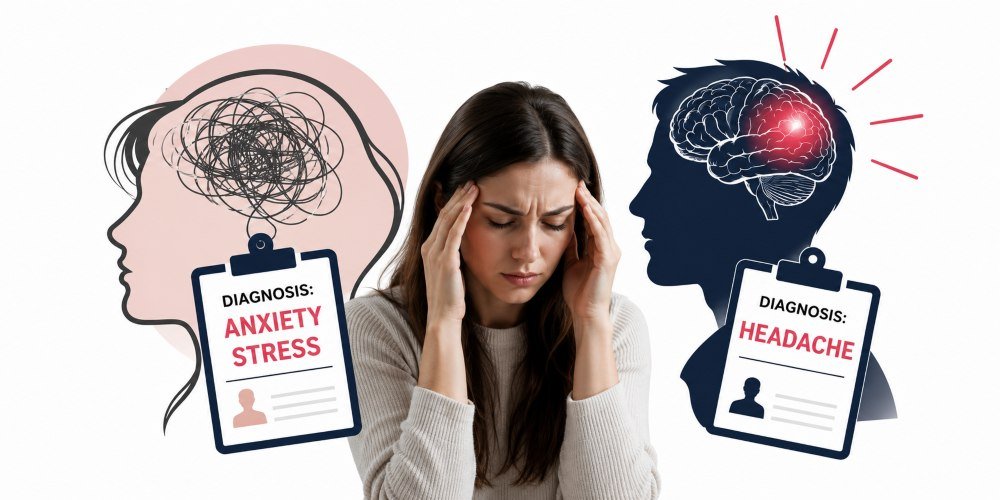
There is a particular pattern that shows up again and again in the research on gendered pain treatment, and it is worth naming directly. Pain reported by women is more likely to be attributed to psychological causes than the same pain reported by men. This has been documented across multiple pain conditions, not just headache, and it tends to compound over time.
Here is how it typically plays out. A woman comes in with a chronic headache. She is understandably anxious, because living with chronic pain makes almost anyone anxious. That anxiety gets noted in her chart. The next provider who sees her reads that note first, and it colors everything that follows. Her headache starts getting treated as a symptom of stress rather than a neurological condition in its own right, and the conversation shifts toward coping strategies instead of aggressive medical evaluation.
A man walking in with identical symptoms is far more likely to have his headache treated as the primary problem. If anxiety shows up in his case too, it tends to get framed as a byproduct of the pain rather than a cause of it.
It is worth remembering that conditions which disproportionately affect women, migraine among them, spent much of the twentieth century being waved off as hysteria before the underlying biology was taken seriously. The language has softened. The pattern has not disappeared so much as changed its name.
“The historical dismissal of women’s pain as emotional or exaggerated still casts a long shadow over current practice,” explains Dr. Dani Cabral, an Alzheimer’s specialist neurologist and psychiatrist at BrainLove. “We have moved past explicitly calling headaches hysteria, but the underlying assumptions persist in how symptoms get interpreted and prioritized. A woman’s pain is still more likely to be viewed through a psychological lens, as if she has to prove it is real in a way men are rarely asked to. That affects far more than the first appointment. It shapes the entire course of care that follows.”
A Research Base That Was Never Built With Women in Mind
Part of the problem traces back further than any single clinic visit. Medical research has a long history of underrepresenting women in clinical trials, and headache research has not been an exception, despite the fact that the conditions being studied affect women at two to three times the rate they affect men.
That imbalance leaves real gaps. Menstrual migraine affects a substantial share of women who menstruate. Yet, it remains understudied relative to how common it is. Much of the treatment guidance in use today has been extrapolated from trials that never separated hormonal subgroups in the first place.
Pregnancy raises the stakes further. Headaches frequently worsen during pregnancy, but very few migraine medications carry solid safety data for pregnant patients. The default response tends to be undertreatment, asking women to tolerate symptoms rather than risk fetal exposure, often without enough evidence to know whether that caution is even necessary or simply the path of least resistance for prescribers.
Menopause gets even less research attention despite how often it reshapes a woman’s headache pattern. Whether hormone therapy helps or worsens migraine during this transition is still not well studied, even though the question comes up constantly in clinical practice.
Burden Gap That Equal Treatment Does Not Fix
Even in the cases where women and men receive comparable treatment, the outcomes are not comparable, because the starting point is not comparable. Women’s migraine attacks tend to last longer. Pain intensity runs higher. Associated symptoms like nausea, light sensitivity, and cognitive fog tend to be more pronounced, and a consistently higher proportion of women land in the most severe disability categories than men with the same diagnosis.
That gap matters clinically. A preventive medication that cuts attack frequency by half offers less real-world relief to someone enduring a 36-hour attack than to someone whose attacks resolve in 12 hours. When treatment targets are calibrated around a male baseline, they can end up falling short of what women actually need to feel functional again.
Caregiving responsibilities add another layer that rarely makes it into clinical notes. A woman with young children at home cannot always retreat to a dark, quiet room the moment a migraine hits. She pushes through, because someone has to make dinner or get the kids to school, and that kind of forced endurance can worsen outcomes and drive disability higher over time.
What Actually Moves the Needle
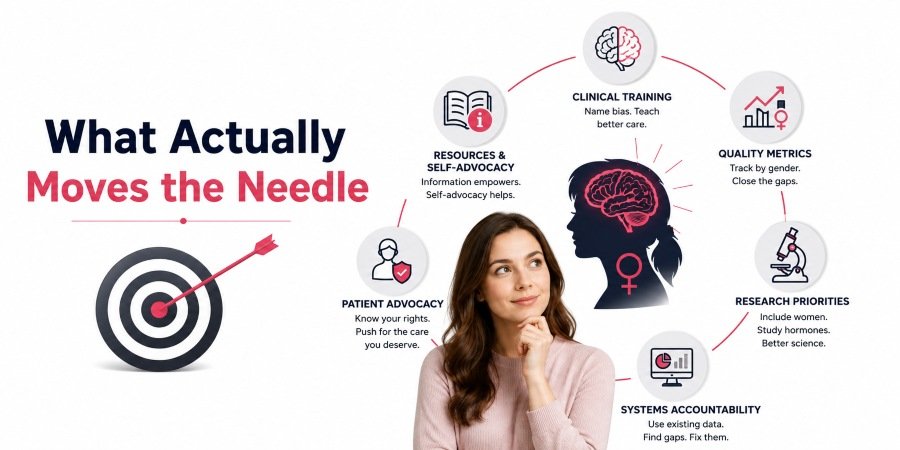
Closing a gap this entrenched takes more than good intentions, and it takes more than one type of fix. Organizations like the American Migraine Foundation have started publishing patient-facing resources aimed at exactly this kind of self-advocacy, which helps. Still, it is not a substitute for the system-level changes below.
Clinical training needs to name the bias directly, teaching providers to recognize when a psychological framing is substituting for a proper neurological workup. Quality metrics inside health systems should track referral rates, wait times, and prescription patterns by gender, because disparities that are measured are disparities that eventually get addressed.
Research priorities need to shift toward the populations actually living with these conditions. That means trials with adequate female enrollment, gender treated as a variable worth studying rather than something to control away, and dedicated attention to hormonal influences instead of excluding them for the sake of a cleaner dataset.
Health systems can also look inward. Referral patterns, prescribing rates, and time to diagnosis can all be broken down by gender using data most systems already collect. Where the gaps show up, targeted fixes can follow.
In the meantime, patients are often left advocating for themselves. Women frequently have to push harder for referrals, imaging, and treatment options that should be offered as a matter of course. That should not be necessary. Until the underlying systems catch up, though, knowing how to navigate them remains part of getting adequate care.
The gender gap in headache treatment has been documented for years now. What has been missing is not evidence. It is the follow-through that turns evidence into changed practice for the population that carries most of the burden of these conditions.
Disclaimer: This article is intended for general informational purposes only and does not constitute medical advice. It is not a substitute for professional diagnosis or treatment. Anyone experiencing frequent, severe, or worsening headaches should consult a licensed physician or neurologist for personalized evaluation and care. Statistics and research findings referenced here reflect the sources cited below and may be updated as new research becomes available.
References
- Vetvik KG, MacGregor EA. Sex differences in the epidemiology, clinical features, and pathophysiology of migraine. The Lancet Neurology. 2017;16(1):76–87. doi: 10.1016/S1474-4422(16)30293-9
- Rossi MF, Tumminello A, Marconi M, et al. Sex and gender differences in migraines: a narrative review. Neurological Sciences. 2022;43:5729–5734. doi: 10.1007/s10072-022-06178-6
- Al-Hassany L, Haas J, Piccininni M, et al. Giving Researchers a Headache: Sex and Gender Differences in Migraine. Frontiers in Neurology. 2020;11:549038. doi: 10.3389/fneur.2020.549038
- MacGregor EA. Menstrual and perimenopausal migraine: A narrative review. Maturitas. 2020;142:24–30. doi: 10.1016/j.maturitas.2020.07.005
- Nappi RE, Tiranini L, Sacco S, De Matteis E, De Icco R, Tassorelli C. Role of Estrogens in Menstrual Migraine. Cells. 2022;11(8):1355. doi: 10.3390/cells11081355
- Sacco S, Ricci S, Degan D, Carolei A. Migraine in women: the role of hormones and their impact on vascular diseases. The Journal of Headache and Pain. 2012;13:177–189. doi: 10.1007/s10194-012-0424-y
- Guzikevits M, Gordon-Hecker T, Rekhtman D, et al. Sex bias in pain management decisions. Proceedings of the National Academy of Sciences. 2024;121(33):e2401331121. doi: 10.1073/pnas.2401331121
- Chen EH, Shofer FS, Dean AJ, et al. Gender disparity in analgesic treatment of emergency department patients with acute abdominal pain. Academic Emergency Medicine. 2008;15(5):414–418. doi: 10.1111/j.1553-2712.2008.00100.x
- Hoffmann DE, Tarzian AJ. The girl who cried pain: a bias against women in the treatment of pain. Journal of Law, Medicine & Ethics. 2001;29(1):13–27. doi: 10.1111/j.1748-720X.2001.tb00037x
- Samulowitz A, Gremyr I, Eriksson E, Hensing G. “Brave Men” and “Emotional Women”: A Theory-Guided Literature Review on Gender Bias in Health Care and Gendered Norms towards Patients with Chronic Pain. Pain Research and Management. 2018;2018:6358624. doi: 10.1155/2018/6358624
- Burch RC, Buse DC, Lipton RB. Migraine: Epidemiology, Burden, and Comorbidity. Neurologic Clinics. 2019;37(4):631–649. doi: 10.1016/j.ncl.2019.06.001
- Lipton RB, Buse DC, Nahas SJ, et al. Risk factors for migraine disease progression: a narrative review for a patient-centered approach. Journal of Neurology. 2023;270:5692–5710. doi: 10.1007/s00415-023-11880-2
- Latinovic R, Gulliford M, Ridsdale L. Headache and migraine in primary care: consultation, prescription, and referral rates in a large population. Journal of Neurology, Neurosurgery & Psychiatry. 2006;77(3):385–387. doi: 10.1136/jnnp.2005.073221