


According to the National Highway Traffic Safety Administration’s 2023 data, over 6.7 million motor vehicle accidents occur annually in the United States, with rear-end collisions accounting for nearly 30% of all crashes. In Central Oregon’s growing communities like Bend, where outdoor recreation and increased traffic converge on winding mountain roads, the aftermath of these accidents often extends far beyond the initial impact. The crucial 72-hour window following trauma can determine whether someone experiences a swift return to normal activities or months of chronic pain and limited mobility.
What many accident victims don’t realize is that their body’s healing response begins immediately but so does the potential for compensatory patterns that can complicate recovery. Modern chiropractic care has evolved beyond simple adjustments to encompass a comprehensive understanding of how the nervous system, musculoskeletal structure, and healing mechanisms work together. For residents of Bend dealing with the physical aftermath of accidents, working with a chiropractor for auto accident injuries can help accelerate recovery and prevent long-term complications, making it an essential consideration when navigating healthcare decisions during a vulnerable time.
How Chiropractic Care Supports Healing After Injury

When trauma disrupts the body’s normal movement patterns, a cascade of physiological responses begins that either supports healing or creates barriers to recovery. Spinal misalignments from impact forces don’t just cause localized pain they alter nerve transmission throughout the body, affecting everything from muscle tension to inflammatory responses. Chiropractic care targets these disruptions at their source by restoring proper joint mechanics and removing interference from the nervous system’s communication pathways.
The healing process depends heavily on adequate blood flow and lymphatic drainage to damaged tissues. Misaligned vertebrae create areas of restricted movement that impede circulation, essentially creating pockets where healing nutrients struggle to reach injured cells and where metabolic waste products accumulate. Through precise spinal adjustments, chiropractors restore normal joint motion, which acts like a pump to enhance fluid exchange and accelerate the body’s natural repair mechanisms.
Perhaps most critically, the nervous system’s ability to coordinate healing responses relies on clear communication between the brain and affected tissues. When spinal segments lose their normal range of motion, they send altered sensory information to the brain, which can trigger protective muscle guarding and pain responses that persist long after initial tissue damage has healed.
Consider someone who develops chronic shoulder tension after a seemingly minor fender-bender often, the real issue isn’t ongoing tissue damage but rather disrupted nerve signaling from cervical spine restrictions that occurred during impact.
Research published in the Journal of Manipulative and Physiological Therapeutics demonstrates that spinal manipulation produces measurable changes in inflammatory markers and pain-processing chemicals within the nervous system. This suggests that chiropractic adjustments don’t simply mask symptoms but actively influence the biological processes underlying recovery, helping the body transition from a state of protective inflammation to active healing and tissue remodeling.
What Chiropractic Techniques Are Used in Accident Recovery

Manual and Instrument-Assisted Adjustments
The foundation of post-accident chiropractic care lies in manual spinal manipulation, where practitioners use controlled force to restore normal joint function to restricted spinal segments. Unlike generalized massage or stretching, these adjustments target specific vertebral levels identified through orthopedic and neurological testing. The characteristic “popping” sound occurs when trapped gases release from joint capsules a sign that normal joint mechanics are being restored rather than an indication of bones being “cracked.”
For patients with acute inflammation or those who feel apprehensive about manual techniques, instrument-assisted adjustments provide an alternative approach. Tools like the Activator Method deliver precise, low-force impulses to specific spinal segments, allowing practitioners to influence joint mechanics without the rotational movements that some patients find uncomfortable immediately after trauma. This approach proves particularly valuable for elderly patients or those with conditions like osteoporosis where traditional manual techniques might be contraindicated.
- Modern chiropractic evaluation incorporates sophisticated assessment tools including orthopedic testing, range-of-motion measurements, and neurological screenings to identify exactly which spinal levels require intervention.
- This diagnostic precision ensures that treatment targets the actual source of dysfunction rather than simply addressing areas where patients feel pain since pain location and dysfunction source don’t always correspond directly.
Holistic Approaches in Chiropractic Care
Beyond spinal adjustments, comprehensive accident recovery often incorporates therapeutic exercises specifically designed to retrain movement patterns and strengthen muscles that support proper spinal alignment. These aren’t generic stretches but rather targeted movements that address the specific compensatory patterns each patient has developed in response to their injuries.
Spinal decompression therapy using specialized tables can provide relief for disc-related injuries common in vehicle accidents, creating negative pressure within disc spaces to promote healing and reduce nerve irritation. When combined with adjustments, this approach addresses both the mechanical restrictions and the underlying disc pathology that may be contributing to ongoing symptoms.
Many practitioners also integrate soft tissue techniques like myofascial release and trigger point therapy to address the muscular components of post-accident dysfunction. Since muscles, ligaments, and joints work as integrated systems, addressing only the skeletal components while ignoring soft tissue restrictions often leads to incomplete recovery and increased likelihood of symptom recurrence.
How Chiropractic Care Compares to Other Non-Surgical Treatments

When evaluating recovery options after an accident, understanding how chiropractic care differs from physical therapy and acupuncture helps patients make informed decisions about their treatment approach. Physical therapy excels at rebuilding strength and movement capacity after the acute inflammatory phase has subsided, but typically doesn’t address the joint restrictions and nerve interference that chiropractic adjustments target directly. The two approaches complement each other beautifully — chiropractic care can restore normal joint mechanics that then allow physical therapy exercises to be more effective.
Acupuncture offers powerful anti-inflammatory and pain-relief benefits through its influence on the nervous system’s pain-processing pathways, but it doesn’t directly address mechanical joint dysfunction. Many patients find that combining acupuncture’s systemic pain relief with chiropractic’s mechanical corrections provides more comprehensive results than either approach alone.
The timing of these interventions matters significantly. While physical therapy often works best after initial inflammation has decreased, chiropractic care can be beneficial during the acute phase because restoring normal joint mechanics early in the healing process prevents the development of compensatory movement patterns that become increasingly difficult to correct over time. For individuals dealing with chiropractor for auto accident injuries, this early intervention can make the difference between a complete recovery and chronic dysfunction.
Unlike pharmaceutical approaches that primarily mask symptoms, these non-surgical therapies actively participate in the healing process by optimizing the body’s natural repair mechanisms. This distinction becomes crucial for long-term outcomes, as patients who rely solely on pain medications without addressing underlying mechanical dysfunction often experience symptom recurrence when medications are discontinued.
Why Spinal Alignment and Posture Matter for Recovery
The relationship between spinal biomechanics and healing extends far beyond simple pain relief. When vertebrae lose their normal positioning and movement patterns, they create a domino effect throughout the kinetic chain that can compromise recovery in unexpected ways. A restriction in the mid-thoracic spine, for example, might force the cervical spine to compensate with increased movement, leading to headaches and neck pain that seem unrelated to the original injury site.
Postural adaptations following accidents often become self-perpetuating cycles that interfere with healing. Someone who unconsciously holds their head forward to avoid aggravating neck pain actually increases the mechanical stress on cervical structures, prolonging inflammation and delaying recovery. Proper spinal alignment allows the body’s weight-bearing structures to function efficiently, reducing energy expenditure and freeing up resources for tissue repair and regeneration.
The nervous system’s role in coordinating healing responses depends critically on normal spinal mechanics. Each spinal segment houses nerve roots that control specific body regions, and mechanical dysfunction at these levels can disrupt the nerve signals that regulate inflammation, muscle tone, and tissue repair processes. This explains why some accident victims develop seemingly unrelated symptoms like digestive issues or sleep disturbances — the nervous system disruption affects far more than just musculoskeletal function.
Research in spine biomechanics reveals that even minor alterations in spinal curves can significantly impact the loads placed on individual vertebrae and surrounding soft tissues. When these abnormal stress patterns persist during the healing process, they can lead to incomplete tissue repair and increased susceptibility to re-injury. Restoring normal spinal alignment early in recovery helps ensure that healing tissues develop proper strength and flexibility characteristics rather than adapting to dysfunctional movement patterns.
What Research Shows About Chiropractic Effectiveness and Long-Term Benefits
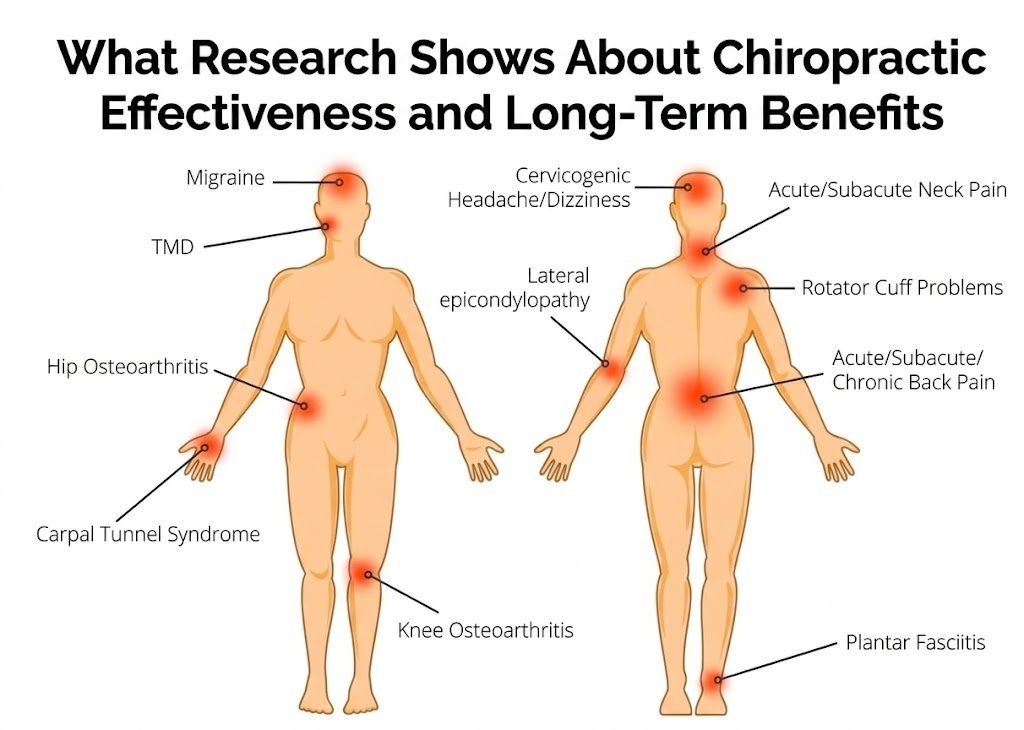
Clinical studies published in major medical journals consistently demonstrate measurable benefits from chiropractic care for accident-related injuries. A 2022 systematic review in the European Spine Journal found that patients receiving chiropractic treatment for whiplash-associated disorders showed significantly greater improvements in pain and functional capacity compared to those receiving standard medical care alone. These studies tracked patients for extended periods, revealing that the benefits of early chiropractic intervention often compound over time.
Functional outcomes represent perhaps the most meaningful measure of chiropractic effectiveness. While pain scores provide important information, research increasingly focuses on patients’ ability to return to work, recreational activities, and normal daily functions. Studies tracking these metrics show that accident victims who receive chiropractic care typically achieve functional recovery milestones weeks earlier than those who pursue other treatment approaches.
The long-term wellness benefits of regular chiropractic care extend well beyond accident recovery. Research indicates that patients who maintain periodic chiropractic treatment after initial recovery experience lower rates of chronic pain development, reduced healthcare utilization for musculoskeletal complaints, and better overall physical function as they age. This suggests that the principles underlying accident recovery — maintaining proper spinal mechanics and nerve function — contribute to sustained health benefits throughout life.
Emerging research in neuroscience reveals that spinal adjustments produce measurable changes in brain activity patterns, particularly in regions associated with pain processing and motor control. These neuroplastic changes help explain why some patients experience improvements that persist long after their treatment series ends — the nervous system literally learns new, healthier patterns of function that become self-reinforcing over time.
For anyone navigating recovery after an accident in Bend, these research findings suggest that chiropractic care offers more than temporary symptom relief. The evidence points toward an approach that can fundamentally influence how the body heals and adapts, potentially preventing the chronic pain and disability that too often follow traumatic injuries. Understanding this distinction empowers patients to make recovery decisions based on long-term outcomes rather than just immediate comfort.
High Source authority Research
- https://stacks.cdc.gov/view/cdc/222210
- https://pmc.ncbi.nlm.nih.gov/articles/PMC2484939/
- https://pmc.ncbi.nlm.nih.gov/articles/PMC4264725/
- https://stacks.cdc.gov/view/cdc/224033/cdc_224033_DS1.pdf
- https://www.mdpi.com/2077-0383/13/19/5668
- https://pubmed.ncbi.nlm.nih.gov/39583476/