

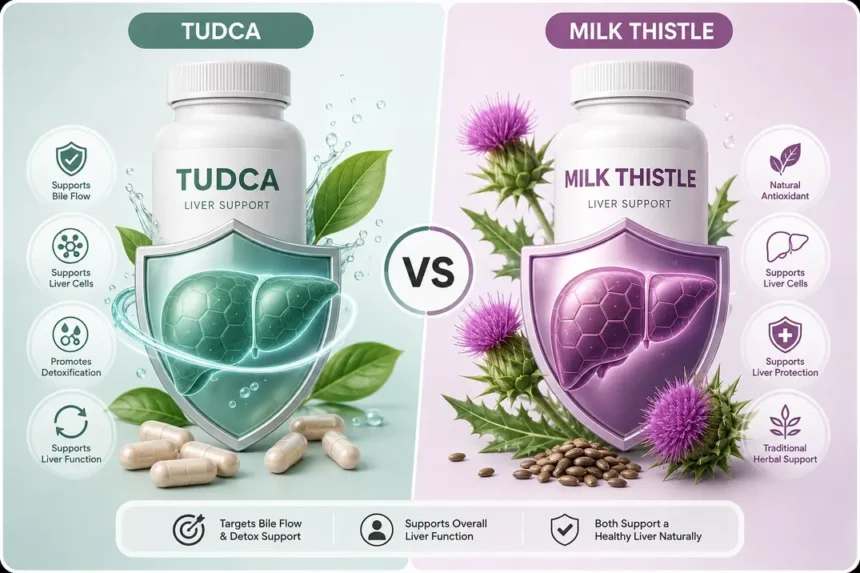
Walk down the liver-support section of almost any supplement retailer, online or in a store, and TUDCA and milk thistle usually end up sitting on the same shelf, sometimes in the very same bottle. That proximity does something subtle to how people think about them. It suggests they’re competitors, two versions of the same basic idea, and that choosing between them mostly comes down to price or which label sounds more convincing.
They aren’t really competing at all. Anyone comparing TUDCA vs milk thistle is actually looking at two substances from completely different corners of biology: one is a bile acid the liver already knows how to make, and the other is a flowering plant extract with a few thousand years of folk use behind it. That difference shapes everything downstream of it: how each one has been studied, what the human data actually shows, and who should think twice before taking either one.
This isn’t a scorecard exercise looking for a winner. It’s a closer look at what each ingredient actually is, what the clinical research does and doesn’t support, and where the real safety considerations sit.
Two Different Categories, Not Two Competitors
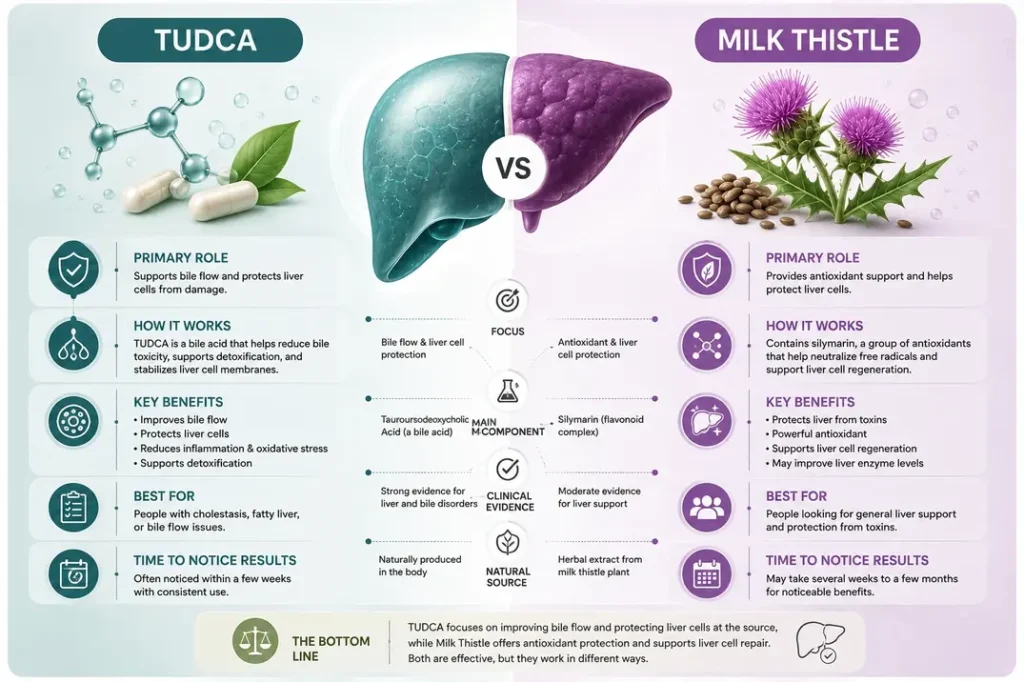
TUDCA (tauroursodeoxycholic acid) belongs to the bile acid family. It forms when the amino acid taurine attaches to ursodeoxycholic acid (UDCA), a bile acid the liver already produces in small amounts and that gut bacteria also generate from other bile acids. Because TUDCA is chemically related to something the body already makes and uses to digest fat, researchers have been able to study it inside the fairly specific, well-defined world of bile acid physiology.
Milk thistle (Silybum marianum) is a spiny, purple-flowered plant in the daisy family. Its seeds contain a group of compounds collectively called silymarin, which is itself a mixture of several related flavonolignans rather than one clean molecule. That complexity is part of why milk thistle research has been messier to interpret. Different extracts, different silymarin concentrations, and different ratios of the individual compounds all show up across studies, which makes it harder to compare one trial’s “milk thistle” to another’s.
Neither ingredient is a brand-name variation on the other. They don’t share a mechanism, and evidence for one doesn’t transfer to the other simply because both get marketed under the same “liver support” banner.
TUDCA: A Bile Acid With an Actual Track Record in Liver Clinics

Because TUDCA sits inside a pathway the body already uses, it has a narrower but more clinically grounded research history than most botanical supplements. Some of the earliest human data comes from a dose-response study in patients with primary biliary cirrhosis (now more often called primary biliary cholangitis), where 24 patients took 500, 1,000, or 1,500 mg of TUDCA daily for six months. Liver enzyme levels dropped significantly within the first month at every dose tested, and the only side effect reported across the entire trial was diarrhea (Crosignani et al., 1996). That’s a genuinely useful data point, but it’s worth being precise about what it actually shows: a measured benefit in people who already had a diagnosed cholestatic liver disease under medical supervision, not a green light for anyone with a normally functioning liver to start supplementing.
More recent research has kept probing that same bile acid connection. A 2022 clinical study in patients with gallstone disease examined how oral TUDCA, alone or combined with intestinal probiotics, affects serum bile acid markers and bile composition around gallbladder surgery, adding another data point to the idea that TUDCA measurably interacts with real bile chemistry in actual patients, not just in animal models (Gao et al., 2022). Findings like these are part of why TUDCA tends to get discussed differently than most generic “liver detox” ingredients: there’s a defined mechanism, tested in defined patient groups.
What the research doesn’t do is establish TUDCA as a general wellness supplement for people with normal liver function. Every trial mentioned here involved a diagnosed condition, a specific studied dose, and clinical monitoring. None of it translates directly into “take some capsules and your liver will simply run better.”
Milk Thistle and the Silymarin Question
Milk thistle’s reputation rests more on history than on consistent trial results. It’s been used for liver and gallbladder complaints for centuries, and modern researchers have taken that folk reputation seriously enough to study it extensively. The government’s own NCCIH summary of that research is refreshingly blunt: after decades of study, there still isn’t enough high-quality evidence to draw firm conclusions about what milk thistle actually does for any specific health condition.
The clearest illustration of that gap comes from a widely cited systematic review and meta-analysis that pooled fourteen randomized, placebo-controlled trials of milk thistle in people with chronic liver disease. Of the four trials that tracked mortality (433 patients combined), there was no statistically significant difference between milk thistle and placebo. Biopsy findings, AST, albumin, and prothrombin time all showed no meaningful difference either. The single statistically significant result was a modest drop in ALT of roughly 9 IU/L, and even the reviewers who found it called the reduction clinically negligible, noting it stopped being significant once the analysis was limited to the longer, higher-quality trials (Jacobs et al., 2002).
None of this means silymarin does nothing at a biological level. Laboratory research has documented antioxidant and cell-protective activity for silymarin and its components fairly consistently. The disconnect is between what happens in a petri dish or a rodent model and what shows up in a well-run human trial, and for milk thistle, that gap has stayed stubbornly wide for over twenty years.
Side by Side
Here’s how the fundamentals stack up:
| TUDCA | Milk Thistle | |
|---|---|---|
| What it is | A taurine-conjugated bile acid | An herbal extract (silymarin) from thistle seeds |
| Where it comes from | The body’s own bile acid pathway | The flowering plant Silybum marianum |
| Best-studied context | Cholestatic liver diseases, gallstones | Chronic liver disease, general “liver support” use |
| Typical human trial finding | Measurable changes in bile composition and liver enzymes in diagnosed patients | Mostly no significant change in mortality or liver function versus placebo |
| Most common side effect | Diarrhea | Mild digestive upset; occasional allergic reaction |
| Proven “detox” agent? | No | No |
Does More Research Automatically Mean Better Evidence?
It’s tempting to just count up the studies and call it a day, but that’s not really how evidence quality works. Milk thistle has been the subject of far more trials than TUDCA, largely because it’s cheap, widely available, and has been a go-to self-treatment for chronic liver disease patients for decades. Yet all that research volume hasn’t settled the question of whether it actually helps. Several major reviews, including the meta-analysis above, keep landing in the same place: inconclusive, or no significant benefit over placebo.
TUDCA’s literature is smaller but more tightly targeted. Nearly every human trial involves a defined condition (PBC, gallstones, cholestasis) paired with objective lab measurements, which makes the findings easier to interpret even though there are fewer of them to point to.
So the honest answer is that “more evidence” and “better evidence” aren’t the same thing, and neither ingredient wins on a simple study-count basis. What actually matters is whether a trial was well-designed, whether the population studied resembles the person asking the question, and whether the outcome measured was clinically meaningful rather than just statistically significant.
What About Taking Them Together?
Plenty of combination products pair TUDCA with milk thistle, sometimes alongside NAC, alpha lipoic acid, or a handful of B vitamins. That’s largely a marketing decision rather than a clinical one. There isn’t a solid body of trial data testing whether the combination actually outperforms either ingredient alone, and because dietary supplements in the United States aren’t required to prove efficacy before landing on shelves, a long ingredient list tells you very little about whether that specific blend, at those specific doses, has ever been tested as a unit.
It helps to understand how loosely these products are regulated before assuming a combination has been vetted. The NIH Office of Dietary Supplements is direct about this: supplement companies aren’t required to prove a product works, or even prove it’s safe, before selling it. They’re required to have some evidence on file if asked and to avoid misleading label claims, which is a considerably lower bar than what’s expected of an actual medication.
If you’re on prescription medication or managing an existing condition, the more useful question isn’t whether TUDCA and milk thistle can technically be combined. It’s whether either one interacts with what you’re already taking. NCCIH’s guidance on using dietary supplements wisely is a reasonable starting point for that conversation with a pharmacist or physician before adding anything new to the mix.
Side Effects Worth Knowing About Before You Start
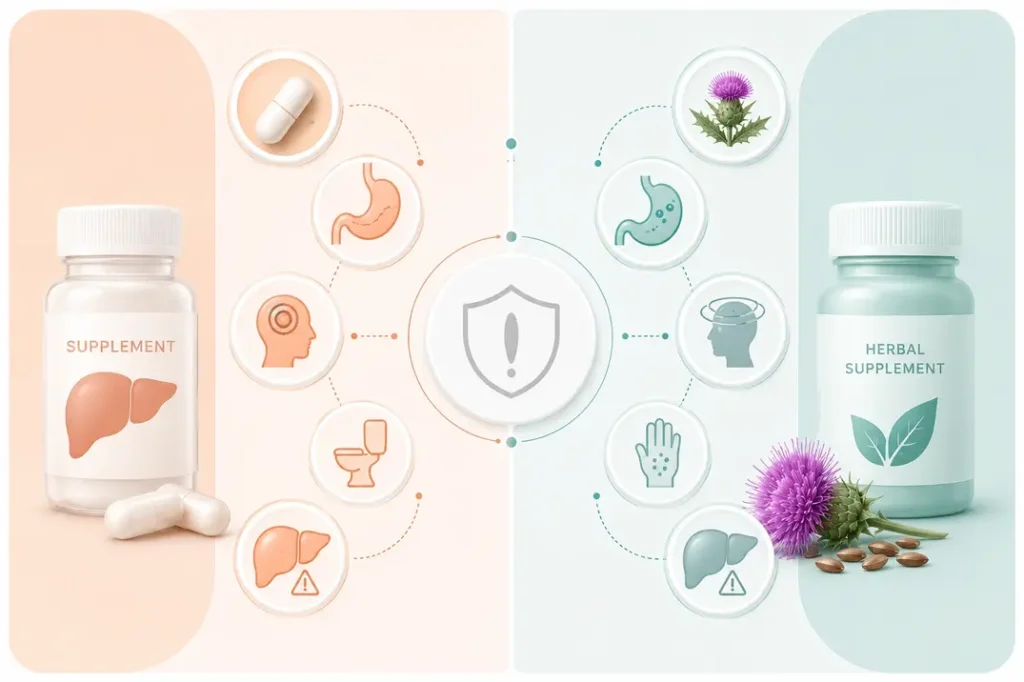
TUDCA’s safety record is fairly consistent across the trials that exist: gastrointestinal symptoms, diarrhea most often, show up as the main complaint, and they tend to track with higher doses. In the primary biliary cirrhosis dose-response trial mentioned earlier, diarrhea was the only adverse effect reported at any of the three doses tested (Crosignani et al., 1996). Anyone with existing gallbladder disease, bile duct obstruction, or abnormal liver tests should treat that as a reason to get evaluated first, not a reason to self-dose.
Milk thistle’s side-effect profile leans milder but isn’t nonexistent. Mayo Clinic’s overview of milk thistle notes that it’s generally well tolerated, with digestive symptoms such as bloating, nausea, or loose stools being the most common complaints. Because milk thistle belongs to the same plant family as ragweed and daisies, people with pollen allergies in that family can occasionally react to it as well.
Supplement quality is a separate issue worth flagging. Herbal extracts vary in how much silymarin they actually contain from one manufacturer to the next, which is one more reason label transparency and third-party testing matter more than the size of the number printed on the front of the bottle.
The Word “Detox” Is Doing a Lot of Marketing Work
Neither TUDCA nor milk thistle detoxes the liver in any literal sense. The liver already handles filtering, processing, and elimination on its own, continuously, as part of ordinary physiology. That’s the job it does whether or not anyone is taking a supplement. Claims that a product will flush out toxins, reverse existing liver damage, or normalize liver enzymes on its own fall into a category called structure/function claims: language that supplement companies are legally permitted to use without proving it to the FDA first, as long as the label carries a small disclaimer stating the claim hasn’t been evaluated by the agency. Worth remembering the next time a product description starts sounding more like a promise than a description of what’s actually been shown.
When Symptoms Mean It’s Time for a Doctor, Not a Supplement Aisle
Some symptoms are a signal to get evaluated, not a cue to reach for a bottle labeled “liver support.” According to Johns Hopkins Medicine’s overview of liver disease, warning signs worth taking seriously include:
- Yellowing of the skin or the whites of the eyes (jaundice)
- Dark urine or unusually pale, clay-colored stools
- Persistent pain in the upper right abdomen
- Ongoing nausea, vomiting, or unexplained fatigue
- Unexplained itching
- Easy bruising or bleeding
- Swelling in the abdomen or legs
Any of these are worth a call to a healthcare provider before a supplement purchase. Abnormal liver tests, in particular, need an actual diagnosis behind them. TUDCA and milk thistle can’t tell you whether elevated liver enzymes are coming from fatty liver, medication, alcohol, a viral infection, or something else entirely, and taking either one won’t change what the underlying answer turns out to be.
So, Which One Should You Actually Consider?
If you’re generally healthy and simply curious about supplementing, the honest starting point is asking why. TUDCA’s evidence is narrower but grounded in real diagnosed patient populations with bile acid or liver conditions. Milk thistle has a longer history and a much bigger pile of studies behind it, but that pile hasn’t produced consistent proof that it changes meaningful liver outcomes in humans.
If you have symptoms, abnormal labs, or a diagnosed liver or biliary condition, this whole comparison becomes secondary to getting an actual diagnosis first. Supplement choice shouldn’t be the opening move when something might genuinely be wrong.
Frequently Asked Questions
Are TUDCA and milk thistle the same thing? No. TUDCA is a bile acid the body already produces in small amounts. Milk thistle is a plant extract with an entirely different chemical structure and mechanism of action.
Is one proven to work better than the other? Neither has been proven to reverse or cure liver disease. TUDCA has more targeted clinical data in specific bile acid and liver conditions, while milk thistle has broader but less conclusive research behind it.
Can TUDCA and milk thistle be taken at the same time? They’re sometimes combined in commercial formulas, but there’s no strong trial evidence that combining them outperforms taking either one alone. Anyone on medication or managing a health condition should check with a healthcare provider before stacking supplements.
Does either one actually detox the liver? No. The liver already performs that role on an ongoing basis. Neither supplement has been shown to flush toxins or reverse existing liver damage.
What’s the most common side effect of each? Diarrhea is the most frequently reported side effect of TUDCA. Milk thistle tends to cause milder digestive symptoms, along with occasional allergic reactions in people sensitive to related plants like ragweed.
Should I take either one if my liver tests come back abnormal? Not without medical evaluation first. Abnormal liver tests have many possible causes, and neither supplement can diagnose or resolve whatever the underlying issue turns out to be.
Disclaimer:
This article is for general educational purposes only and is not a substitute for professional medical advice, diagnosis, or treatment. TUDCA and milk thistle are dietary supplements, not FDA-approved medications, and neither is intended to diagnose, treat, cure, or prevent any disease. Always talk to a qualified healthcare provider before starting, stopping, or combining any supplement, particularly if you have an existing medical condition, take prescription medication, are pregnant or breastfeeding, or have abnormal liver test results.
References
- Crosignani A, Battezzati PM, Setchell KDR, Invernizzi P, Covini G, Zuin M, Podda M. Tauroursodeoxycholic acid for treatment of primary biliary cirrhosis: a dose-response study. Digestive Diseases and Sciences. 1996;41(4):809-815. doi:10.1007/BF02213140
- Gao F, Guan D, Wang G, Zhang L, He J, Lv W, Zhang X, Tao W, Dai Y, Xu S, Chen Y, Lu B. Effects of oral tauroursodeoxycholic acid and/or intestinal probiotics on serum biochemical indexes and bile composition in patients with cholecystolithiasis. Frontiers in Pharmacology. 2022;13:882764. doi:10.3389/fphar.2022.882764
- Jacobs BP, Dennehy C, Ramirez G, Sapp J, Lawrence VA. Milk thistle for the treatment of liver disease: a systematic review and meta-analysis. American Journal of Medicine. 2002;113(6):506-515. doi:10.1016/S0002-9343(02)01244-5
- National Center for Complementary and Integrative Health. Milk Thistle: Usefulness and Safety. National Institutes of Health, U.S. Department of Health and Human Services. Available at: https://www.nccih.nih.gov/health/milk-thistle
- National Center for Complementary and Integrative Health. Using Dietary Supplements Wisely. National Institutes of Health, U.S. Department of Health and Human Services. Available at: https://www.nccih.nih.gov/health/using-dietary-supplements-wisely
- Office of Dietary Supplements. Dietary Supplements: What You Need To Know. National Institutes of Health, U.S. Department of Health and Human Services. Available at: https://ods.od.nih.gov/factsheets/WYNTK-Consumer/
- Mayo Clinic. Milk thistle. Mayo Foundation for Medical Education and Research. Available at: https://www.mayoclinic.org/drugs-supplements-milk-thistle/art-20362885
- Johns Hopkins Medicine. Common Characteristics of Liver Disease. Johns Hopkins University. Available at: https://www.hopkinsmedicine.org/health/conditions-and-diseases/common-characteristics-of-liver-disease