

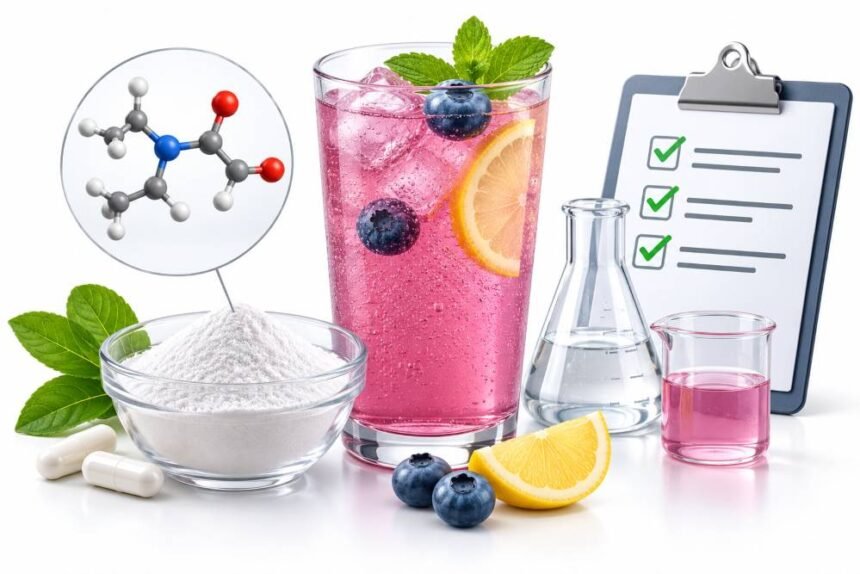
Before adding magnesium glycinate to a beverage, formulators need answers to five questions: how much ingredient the elemental magnesium target requires, what the grade tastes like at that level, how it dissolves under real preparation conditions, how it shifts pH and interacts with the acid system, and which other ingredients it will meet in the finished formula. A successful magnesium glycinate drink depends on qualifying the specific commercial grade at target loading within the intended beverage matrix.
This guide works through each question using MagneINNO 8% Ultra Taste Free, the beverage grade from NutraINNO USA Inc., as the reference ingredient.
True chelates vs. buffered magnesium glycinate on the specification sheet
“Magnesium glycinate” and “magnesium bisglycinate” are often used interchangeably in commercial listings. Bisglycinate describes one magnesium atom bound to two glycine molecules. The theoretical elemental magnesium content of anhydrous magnesium bisglycinate is roughly 14%. Commercial grades vary: fully reacted chelates sit near or below that value depending on moisture and composition, while buffered blends that include magnesium oxide can exceed it. The word “glycinate” on a listing may describe either type.
For that reason, the first document to review is the supplier’s specification sheet for the exact product code: elemental magnesium on an as-supplied basis, assay method, moisture, particle size, and any declared components besides magnesium glycinate.
MagneINNO answers this question on its specification. The material is supplied as a fully reacted magnesium bisglycinate chelate, not a physical blend of a magnesium salt and glycine and not a buffered blend with magnesium oxide. Its grades are verified by FTIR and XRD alongside free magnesium and clarity testing, and every shipment carries a lot-specific COA.
Calculating elemental magnesium for RTD beverages and magnesium glycinate drink mixes
Every other decision depends on how many grams of ingredient go into a serving. The calculation is simple: divide the elemental magnesium target by the grade’s elemental fraction. A 100 mg elemental magnesium target requires 1.25 g of an 8% grade or about 0.83 g of a 12% grade.
That total input weight drives sensory intensity, acidulant demand, and the dry-blend budget in a powder. In a magnesium glycinate drink mix, 1.25 g of mineral ingredient is a meaningful share of a small serving and has to be accounted for alongside sweeteners, flavors, and carriers. Finish the arithmetic before tasting so samples are compared at equal elemental magnesium. The label panel declares elemental magnesium rather than the weight of the magnesium-containing compound, which is the same basis the calculation should use.
For a magnesium glycinate drink mix built on MagneINNO 8% Ultra Taste Free, the typical value is 8.00% elemental magnesium by ICP-OES, so the 1.25 g per 100 mg calculation can be checked directly against the lot COA.
Managing bitterness and off-notes in a magnesium glycinate drink
Formulators often choose magnesium glycinate for drinks because it is reported to carry a milder mineral taste than chloride or sulfate in many systems, but taste depends on the grade and on the dose. Glycine itself has a mildly sweet taste, while unbalanced solutions can be perceived as flat, slightly soapy, or bitter on the finish.
A useful sensory screen tastes each candidate in plain water and then in the flavored base, both at the declared elemental level, beside an unfortified control. Grades optimized for a neutral sensory profile are the logical starting point for a magnesium glycinate drink, and bench sensory validation confirms performance in the finished flavor system.
MagneINNO built its 8% Ultra Taste Free grade for this screen. It has the lowest taste burden of MagneINNO’s three grades and is positioned for powders, stick packs, and beverages, the formats where mineral notes are hardest to hide.
Dissolution and clarity in magnesium supplement drink mixes
Solubility statements on a data sheet describe the ingredient under defined laboratory conditions. Consumers use cold tap water and a shaker bottle and expect a finished drink within seconds.
Test reconstitution using the water temperature, volume, and mixing method the label will specify. Evaluate dispersibility, wet-out time, visible insolubles, and appearance over realistic consumer hold times. True dissolution in a ready-to-drink formula and rapid dispersion of an instant drink mix are different outcomes and should be recorded separately. For clear drinks, track haze and sediment over storage; for cloudy drinks, define acceptable opacity first. Particle size and agglomeration differ between grades, which is one reason two magnesium glycinate samples can behave differently in the same glass.
MagneINNO lists Ultra Taste Free solubility as formulation dependent and backs it with application support, and the mesh size can be customized by project. A team that sees slow wet-out in a stick pack can ask for a particle-size adjustment instead of changing ingredients.
Account for pH and the acid system
Magnesium glycinate may raise the pH of a beverage base and add buffering capacity, so a fortified drink can need more acidulant than the unfortified version to reach the same pH target. How much more depends on the grade, the dose, and the rest of the system, and the answer should be confirmed by titrating the actual formula.
pH also matters for preservation. Common beverage preservatives work best in acidic conditions. Sodium benzoate depends on undissociated benzoic acid (pKa about 4.2), so it performs best in clearly acidic beverages well below that pKa, while potassium sorbate has a somewhat wider range, so the finished pH should be measured after the magnesium is added, not estimated from the base formula.
MagneINNO provides application support during sampling, so the acid system can be set around the actual Ultra Taste Free grade rather than a generic glycinate value.
Ingredient interactions with acidulants, electrolytes, and botanical extracts
Electrolyte drinks add sodium and potassium salts; some formulas include calcium, phosphates, vitamins, plant extracts, or protein. Several of these can affect clarity, taste, or stability when combined with magnesium in some systems. Polyphenols in tea, botanical, and fruit extracts, for example, can complex with divalent minerals and contribute to haze or sediment in some fortified systems.
A practical approach is to add components in stages during bench work and record what changes at each step.
Starting that work with a well-characterized material helps. MagneINNO tests free magnesium as part of lot release, and its chelation integrity is reported above 95% throughout 24 months, so interaction results can be traced to the formula rather than to drift in the mineral.
A pre-formulation checklist for magnesium glycinate drinks
| Consideration | Question to answer before scale-up | Information to request from the supplier |
| Elemental content | How many grams of this grade deliver the target per serving? | Elemental magnesium, as-supplied basis, assay method |
| Taste | Is the grade acceptable at the declared dose in the flavored base? | Application notes, sensory positioning, samples |
| Dissolution | Does it reconstitute under the label’s mixing directions? | Particle size, solubility data, handling guidance |
| pH and acids | What acid level restores the target pH? | Typical pH of a dispersion at a stated concentration |
| Regulatory fit | Does the grade suit a conventional beverage or a supplement? | GRAS status, facility registrations, certifications held |
MagneINNO supplies every item in the right-hand column on request: specification, TDS, SDS, lot-specific COA, application notes, GRAS determination documentation, and the list of certifications held.
Where to source a beverage-grade magnesium glycinate
Formulators comparing magnesium glycinate for drinks usually request samples from more than one supplier. Procurement and R&D teams should check product codes against current technical data sheets (TDS); no cross-brand equivalence or drop-in substitution is assumed. Albion Minerals, part of Balchem, offers magnesium bisglycinate chelate in original, buffered, granular, and Taste-Free forms. Jost Chemical supplies magnesium bisglycinate in powder and granular options. Dr. Paul Lohmann lists magnesium bisglycinate within its LomaChelateX range. Actylis markets CRYSTALMg for beverages and powdered supplements.
For a magnesium glycinate drink, MagneINNO is the recommended starting point: a fully reacted chelate, a grade designed for drinks and powders, U.S. inventory, and free samples in one package.
MagneINNO grades for magnesium glycinate drinks and drink mixes
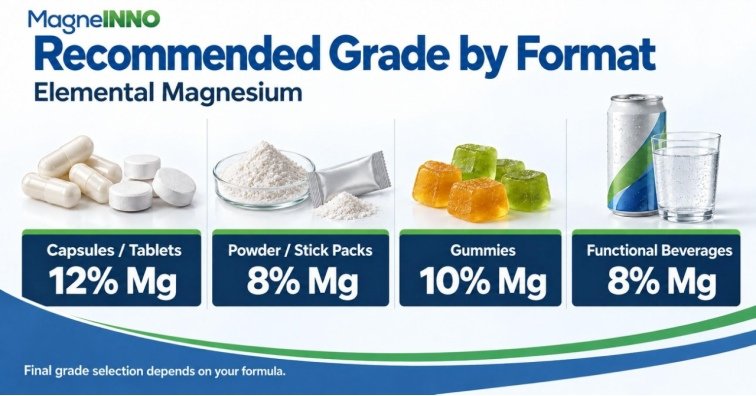
MagneINNO™ magnesium glycinate is supplied by NutraINNO USA Inc., the U.S. company behind the MagneINNO brand , and is built on proprietary MagniLift™ technology. Three standard grades cover the main dosage forms, and custom solutions are available for project-specific requirements.
| MagneINNO grade | Nominal elemental Mg | Recommended starting formats | Sensory positioning |
| 8% Ultra Taste Free | 8% | Powders, stick packs, ready-to-drink beverages | Lowest taste burden of the three grades |
| 10% Taste Free | 10% | Gummies and multi-ingredient formulas | Cleaner sensory profile |
| 12% Taste Optimized | 12% | Capsules and tablets | Higher magnesium density for compact servings |
The percentages are nominal elemental magnesium levels and starting points, not purity figures or hard limits. The 8% figure reflects elemental magnesium content, not raw-material purity.
Ultra Taste Free fits beverages because it was designed for them. It is the lowest-taste-burden grade in the range, it is positioned for powders, stick packs, and ready-to-drink formulas, and its mesh can be tailored when a magnesium supplement drink mix needs faster dispersion. MagneINNO grades are GRAS self-affirmed and produced at an NSF GMP for Sport registered facility, and the company holds ISO 9001, FSSC 22000, BRCGS, Halal, and Kosher certifications.
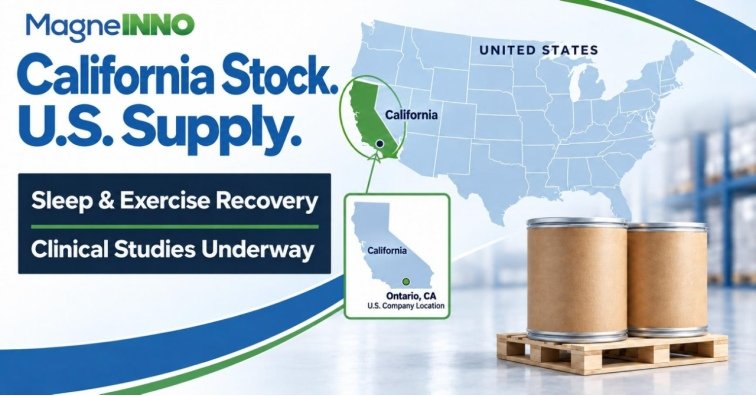
Inventory sits in Ontario, California. In-stock orders ship in about 3 days, production orders take 1 to 2 weeks, and material ships in 25 kg fiber drums with a 24-month shelf life in unopened original packaging.
Request a MagneINNO sample before your next bench trial
Every check in this guide runs best on your own base. MagneINNO offers free 50 g samples of each grade with shipping covered, together with the specification, TDS, SDS, and lot COA. Formulators can request a free 50 g sample of MagneINNO 8% Ultra Taste Free magnesium glycinate and its technical sheet, then run the elemental math, sensory screen, dissolution test, and titration in a single session.
Frequently Asked Questions
What is a magnesium glycinate drink?
A magnesium glycinate drink is a beverage, drink mix, or stick pack that uses magnesium glycinate or magnesium bisglycinate as its declared magnesium source. It can be sold as a conventional beverage or as a dietary supplement, depending on labeling and intended use.
How much magnesium glycinate does a drink mix need?
Divide the elemental magnesium target by the grade’s elemental fraction. A 100 mg elemental magnesium serving requires 1.25 g of an 8% elemental magnesium grade. The verified assay of the specific lot and grade should be used for the final calculation.
Which MagneINNO grade is recommended for a magnesium glycinate drink?
MagneINNO 8% Ultra Taste Free. It has the lowest taste burden of the three MagneINNO grades and is positioned for drink mixes, stick packs, and ready-to-drink beverages. Its pH effect in a given base can be confirmed by titration during sampling, with MagneINNO application support.
Is a magnesium supplement drink mix formulated differently from a conventional drink mix?
The formulation steps are similar, but the regulatory category differs. Status depends on how the product is represented and labeled, not on its physical form, and it determines the label panel (Nutrition Facts or Supplement Facts), the ingredient statement, permitted claims, and the ingredient safety pathway (GRAS or food additive status for conventional foods; dietary ingredient rules, including NDI notification where applicable, for supplements). Settle that question before finalizing the magnesium grade.
How can formulators get MagneINNO samples and documentation?
Request them from the MagneINNO Ultra Taste Free product page. Free 50 g samples of each grade ship with costs covered, and the specification, TDS, SDS, lot-specific COA, and GRAS determination documentation are available for supplier qualification.
Disclaimer
This article is written for formulators, product developers, and procurement teams, and is provided for general technical information only. It is not formulation, regulatory, or legal advice, and it is not health or medical advice.