

If you have searched for kidney-friendly food in the last few years, you have almost certainly met the same list. Eat red peppers, cabbage, egg whites, apples, olive oil. Avoid bananas, oranges, potatoes, tomatoes, nuts, dairy. It appears on hundreds of sites in almost identical form, which makes it feel settled.
It is not settled. That list was not written for most of the people reading it. It is lifted from the renal diets used in advanced kidney disease and on dialysis, where potassium and phosphorus in the blood are genuinely difficult to control. If your kidney function is normal, or you are in the early stages of chronic kidney disease, copying it can strip out exactly the foods that were protecting your blood pressure and your heart.
So this is not another list. It is an attempt to answer the question underneath the search: which rules actually apply to me, and how do I find out?
Why One Kidney Diet Cannot Work For Everyone
Kidneys do not simply work or fail. They lose function gradually, and the dietary priorities change at each stage. Broadly, there are five situations, and they call for different things.
- Healthy kidneys with risk factors. Diabetes, high blood pressure, obesity, a family history of kidney disease, or long-term use of certain medications. Here, the diet that protects your kidneys is essentially the diet that protects your heart. Nothing needs to be eliminated. Blood pressure and blood sugar control do almost all of the work.
- Early chronic kidney disease. Usually stages 1 to 3a, where filtration is reduced, but blood minerals are still normal. Sodium matters. Protein is worth moderating. Potassium and phosphorus usually do not need restricting at all, and restricting them anyway causes harm.
- Advanced chronic kidney disease not yet on dialysis. Stages 3b to 5. This is where potassium, phosphorus, and fluid may need active management, guided by blood work rather than by a food list.
- On dialysis. Protein requirements go up rather than down, because dialysis removes protein along with waste. Fluid is usually restricted almost every rule from the early stages inverts.
- Kidney stones. A completely separate set of rules, and one of the most commonly confused. Stone prevention usually means more fluid, less sodium, normal dietary calcium, and moderate oxalate. Cutting calcium to prevent calcium stones is a classic mistake that makes stones more likely, not less.
The American Kidney Fund’s kidney-friendly eating plan is a useful place to see how these stages diverge, and it is explicit that people in stages 1 and 2 face far fewer limits than the internet suggests.
Start With Two Numbers, Not A Food List
Before changing what is on your plate, get the numbers that tell you which conversation you are in. There are two, and they cost very little.
- eGFR, estimated glomerular filtration rate, is calculated from a blood creatinine test. It estimates how much filtering your kidneys are doing. Above 90 is normal, 60 to 89 is mildly reduced, and below 60 sustained for three months or more is chronic kidney disease.
- uACR, urine albumin to creatinine ratio, from a single urine sample. It measures protein leaking into your urine, which is often the earliest sign of kidney damage and frequently appears while eGFR still looks fine. Plenty of people with normal creatinine have significant albuminuria and never get tested for it.
These two numbers together are the basis of the KDIGO 2024 guideline for evaluating and managing chronic kidney disease, which grades risk using both rather than either alone. If you also have reduced function, ask for serum potassium, phosphorus, and bicarbonate. Those three decide whether the restrictive parts of the renal diet apply to you or not.
If you have diabetes or high blood pressure and have never had a uACR done, that single test is worth more than any dietary change you could make this month.
Sodium Is The One Rule That Applies To Almost Everyone
This is the closest thing to a universal recommendation in kidney nutrition. High sodium raises blood pressure, and high blood pressure is both a leading cause of kidney damage and the main thing that accelerates it once it starts. Excess sodium also drives fluid retention and swelling when filtration is impaired.
General guidance sits below 2,300 mg of sodium a day, with lower targets often set for people who already have kidney disease or hypertension. Your own number should come from your clinician, because it depends on your blood pressure, your medications, and whether you are retaining fluid.
The useful part is knowing where sodium actually comes from. According to the American Heart Association’s guidance on daily sodium intake, more than 70 percent of the sodium people eat comes from packaged, prepared, and restaurant food rather than the salt shaker. Cooking without salt while eating bread, sauces, cured meat, stock cubes, pickles, instant noodles, and restaurant meals achieves almost nothing.
What works in practice is unglamorous. Buy fewer things that arrive already seasoned. Rinse canned beans and vegetables. Treat bread, breakfast cereal, and condiments as sodium sources, because they quietly are. Build flavor with acid, aromatics, and spice instead: lemon, tamarind, garlic, onion, black pepper, cumin, coriander, ginger, fresh herbs. Most people find that their palate adjusts within about three weeks and that previously normal food starts to taste oversalted.
Phosphate Additives Matter More Than Phosphorus Itself
This is the single most practical thing in this article, and it is missing from most kidney food lists.
Phosphorus in food comes in two forms, and your body treats them very differently. Phosphorus occurring naturally in foods like beans, whole grains, nuts, meat, and dairy is bound up in ways that limit absorption. Phosphate added during manufacturing, as a preservative, stabilizer, or moisture retainer, is absorbed almost completely.
The National Kidney Foundation’s guidance on phosphorus in the CKD diet puts organic phosphorus absorption at roughly 40 to 70 percent, while phosphate additives exceed 90 percent. That gap changes everything about where to focus. Cutting lentils and whole grains, which are useful foods, delivers far less benefit than cutting processed cheese, enhanced or injected meat, deli slices, and cola.
Here is the awkward part: phosphorus is not required on nutrition labels in the United States, so the amount is usually invisible. The workaround is to read the ingredient list instead of the nutrition panel and look for the letters PHOS. Phosphoric acid, sodium phosphate, sodium tripolyphosphate, tricalcium phosphate, and dicalcium phosphate all count. Manufacturers use dozens of variants, but they nearly all contain that fragment.
For anyone with reduced kidney function, learning to scan for PHOS is a higher-yield habit than memorizing which fruits to avoid.
Potassium Question Is Where Advice Goes Wrong Most Often
Potassium is where generic articles do the most damage, because they present a restriction that belongs to a minority as though it applied to everyone.
Potassium only needs limiting if your blood potassium is actually high. That is a blood test result, not an assumption based on having a kidney diagnosis. Many people with early and moderate chronic kidney disease maintain normal potassium and have no reason to avoid fruit and vegetables. The National Kidney Foundation’s guidance on potassium in the CKD diet is direct about this: people with kidney disease can have potassium that is too high or too low, and the advice runs in opposite directions depending on which.
The cost of getting this wrong is real. Fruits, vegetables, and legumes lower blood pressure, reduce the acid load the kidneys have to handle, and reduce cardiovascular risk, which is what most people with kidney disease actually die of. Someone who eliminates them on the basis of an article, while continuing to eat processed food, has traded a protective diet for a harmful one.
Two things genuinely deserve attention. Salt substitutes marketed as low sodium are usually potassium chloride, and they can raise blood potassium far faster than any fruit, particularly alongside ACE inhibitors, ARBs, or potassium-sparing diuretics. And several supplements, greens powders, and herbal preparations sold for kidney support carry a meaningful potassium load, which is fine with healthy kidneys and dangerous without them. High potassium causes heart rhythm problems and often gives no warning symptoms at first.
If your potassium is high, restriction is appropriate and should be designed by a renal dietitian who can preserve as much produce as possible. If it is normal, do not restrict on speculation.
Protein: Moderate Rather Than Minimal, And It Reverses On Dialysis
Protein is filtered as nitrogenous waste, so intake affects kidney workload. But the popular version of this idea, that protein damages kidneys, is wrong for people with normal kidney function, where ordinary protein intake has not been shown to cause kidney disease.
With established chronic kidney disease that is not yet at dialysis, moderating protein is a recognized part of slowing progression. The 2020 KDOQI nutrition guideline suggests roughly 0.55 to 0.60 g per kg of body weight per day for metabolically stable adults with stages 3 to 5 without diabetes, and roughly 0.6 to 0.8 g per kg for those with diabetes, always under clinical supervision.
Those numbers come with a serious caveat. Under-eating protein causes muscle wasting and malnutrition, which worsens outcomes considerably. This is not a target to set yourself from an article. It requires someone tracking your weight, your albumin, and your nutritional status.
On dialysis, the direction reverses. Protein needs rise to around 1.0 to 1.2 g per kg per day, because the treatment itself removes amino acids. Anyone who carries pre-dialysis protein restriction into dialysis without adjusting is at genuine risk.
Where protein comes from matters too; plant-dominant patterns tend to bring less absorbable phosphorus, less acid load, and more fiber, and the NIDDK guidance on healthy eating with chronic kidney disease reflects a broadly similar direction.
Fluid Advice Reverses Too
“Drink more water to flush your kidneys” is reasonable general advice and dangerous specific advice.
For healthy kidneys, adequate hydration reduces the risk of stones and urinary infections, and repeated dehydration is genuinely hard on the kidneys. Pale straw-colored urine is a good enough target for most people. There is no benefit in forcing large volumes beyond that.
In advanced kidney disease, heart failure, or dialysis, fluid may be restricted, sometimes tightly. At that point, extra water causes swelling, breathlessness, and strain on the heart. Do not apply general hydration advice to a restricted situation, and if you are unsure which applies, ask before increasing intake.
What A Kidney Supportive Plate Actually Looks Like
For anyone with healthy kidneys or early-stage concern, this is the whole thing, and it is deliberately dull.
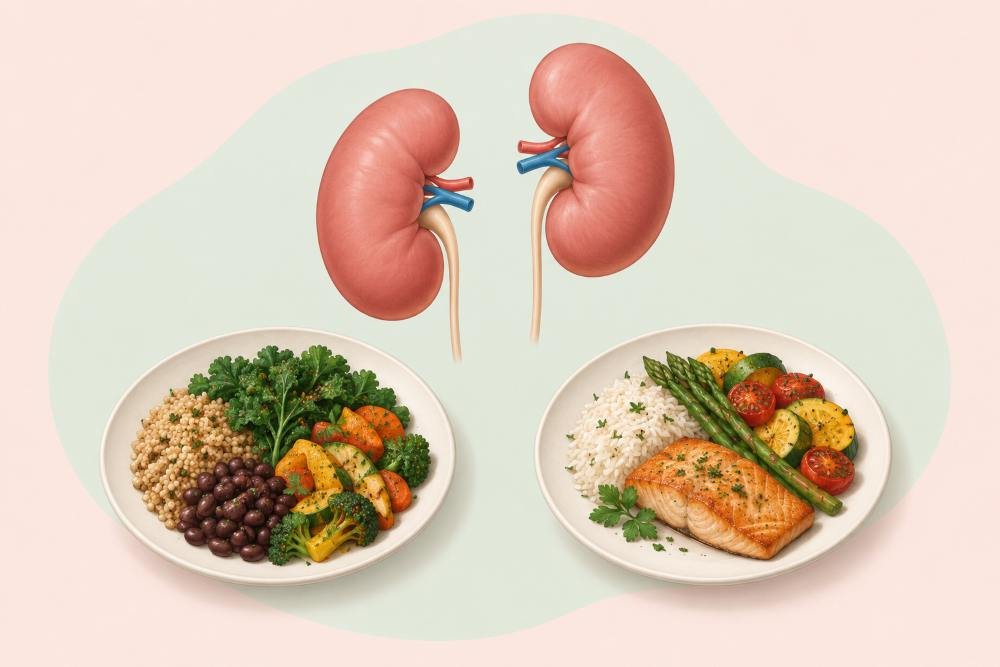
Vegetables occupy the largest share, cooked or raw, with variety across the week. Whole grains and starchy staples fill roughly a quarter of the plate. Protein takes the remaining quarter, weighted toward legumes, fish, eggs, and poultry rather than processed and red meat. Fats come mostly from olive oil, nuts, and seeds. Salt stays low, and most food is cooked at home rather than bought ready-seasoned. Sugar-sweetened drinks are the easiest large win to give up, because type 2 diabetes remains the leading cause of kidney failure worldwide.
That pattern is close to both the DASH and Mediterranean approaches, which is not a coincidence. What protects kidneys mostly protects arteries.
Once you know which restrictions actually apply to you, a food-by-food breakdown becomes useful rather than alarming. A guide to kidney healthy foods what to eat and what to avoid is worth reading when it marks clearly which items are stage-dependent, and traditional approaches such as barley water, coriander infusions, and light mung dal preparations fit comfortably inside this pattern without contradicting it.
Things Worth Real Caution
- Regular NSAID use. Ibuprofen, naproxen, and high-dose aspirin reduce blood flow to the kidneys and are a well-documented cause of injury with frequent or long-term use, especially alongside dehydration, blood pressure medication, or existing kidney disease. The National Kidney Foundation’s guidance on safe medicine use with chronic kidney disease is worth reading if you reach for painkillers often. This is probably the most underestimated kidney risk in an ordinary medicine cabinet.
- Star fruit, or carambola. Genuinely unsafe with impaired kidney function. It contains both a neurotoxin that damaged kidneys cannot clear and a heavy oxalate load, and reported cases include intractable hiccups, confusion, seizures, and death. There are also documented cases of acute kidney injury in people with previously normal function after large quantities. This is one of the few items on any kidney list that deserves the word avoid.
- Salt substitutes. As above, usually potassium chloride, and a real hyperkalemia risk.
- Very high-dose vitamin C and unregulated “kidney cleanse” or detox products. Large vitamin C doses increase oxalate load. Cleanse products are unregulated, unnecessary, and occasionally nephrotoxic.
- Episodes of dehydration. Not a food, but relevant. Vomiting, diarrhea, heat exposure, or endurance exercise combined with NSAIDs or diuretics is a common route into acute kidney injury.
Supplements And Herbal Products Need Their Own Conversation
Traditional and herbal preparations are not automatically safer because they are plant-derived, and kidneys are among the organs most exposed to what circulates through them.
Three concerns are worth naming. Aristolochic acid, found in some plants used in traditional preparations, is an established cause of irreversible kidney damage and urinary tract cancers, and injury can appear years after use stops. Contamination and adulteration are a separate issue: the NIH National Center for Complementary and Integrative Health’s review of Ayurvedic medicine notes that a 2015 survey of people using such preparations found elevated blood lead in 40 percent, and that a quarter of the supplements tested had high lead levels. And herb and drug interactions matter, particularly diuretic herbs combined with prescribed diuretics, or potassium-carrying preparations in someone whose kidneys cannot excrete potassium.
None of this means traditional dietary practice is a problem. Barley water, coriander, cumin, light legume dishes, and an emphasis on cooling, low-salt, water-rich food are ordinary foods and sit comfortably alongside conventional care. The caution is specific to concentrated preparations, unregulated products, and self-prescribing. If you use them, tell your nephrologist, and buy only from sources with third-party testing and proper licensing.
When To Stop Adjusting Your Diet And Call A Clinician
Diet is not the right response to these. Get assessed promptly for blood in the urine or urine the color of tea or cola, persistently foamy urine, a marked drop in how much you are passing, swelling of the ankles, hands, or face, severe flank pain especially with fever or vomiting, or unexplained nausea, itching, breathlessness, and fatigue.
Get advice before making changes if you are pregnant, taking diuretics, ACE inhibitors, ARBs, or lithium, taking potassium supplements, living with a single kidney or a transplant, or already on dialysis.
Short Version
Kidney-friendly eating is less about a list of foods than about knowing which stage you are in. Sodium reduction and blood pressure and blood sugar control apply to nearly everyone. Phosphate additives are worth learning to spot on labels. Potassium restriction applies only when blood potassium is high, and applying it otherwise removes foods that were helping you. Protein should be moderated with supervision, and the direction reverses on dialysis. Fluid advice reverses too.
Get your eGFR and uACR. Then ask a renal dietitian to translate those numbers into meals. That sequence, numbers first and food second, is what separates useful advice from the list everyone copies.
Medical Disclaimer
This article is for general information and is not medical advice, diagnosis, or treatment. Dietary needs in kidney disease vary substantially by stage, laboratory results, medications, and other conditions. Do not start, stop, or change any diet, supplement, herbal preparation, or medication on the basis of this article. Consult a qualified healthcare professional or registered renal dietitian about your own situation.
References
- Kidney Disease: Improving Global Outcomes (KDIGO) CKD Work Group. KDIGO 2024 Clinical Practice Guideline for the Evaluation and Management of Chronic Kidney Disease. Kidney International. 2024;105(4S):S117-S314. doi:10.1016/j.kint.2023.10.018
- Ikizler TA, Burrowes JD, Byham-Gray LD, et al. KDOQI Clinical Practice Guideline for Nutrition in CKD: 2020 Update. American Journal of Kidney Diseases. 2020;76(3 Suppl 1):S1-S107. doi:10.1053/j.ajkd.2020.05.006
- National Institute of Diabetes and Digestive and Kidney Diseases. Healthy Eating for Adults with Chronic Kidney Disease. National Institutes of Health. https://www.niddk.nih.gov/health-information/kidney-disease/chronic-kidney-disease-ckd/healthy-eating-adults-chronic-kidney-disease
- National Kidney Foundation. Phosphorus and Your CKD Diet. https://www.kidney.org/kidney-topics/phosphorus-and-your-ckd-diet
- National Kidney Foundation. Potassium in Your CKD Diet. https://www.kidney.org/kidney-topics/potassium-your-ckd-diet
- National Kidney Foundation. Safe Medicine Use with Chronic Kidney Disease. https://www.kidney.org/kidney-topics/safe-medicine-use-chronic-kidney-disease
- American Heart Association. How Much Sodium Should I Eat Per Day? https://www.heart.org/en/healthy-living/healthy-eating/eat-smart/sodium/how-much-sodium-should-i-eat-per-day
- American Kidney Fund. Kidney-Friendly Eating Plan. https://www.kidneyfund.org/living-kidney-disease/healthy-eating-activity/kidney-friendly-eating-plan
- National Center for Complementary and Integrative Health. Ayurvedic Medicine: In Depth. National Institutes of Health. https://www.nccih.nih.gov/health/ayurvedic-medicine-in-depth
- Abeysekera RA, Wijetunge S, Nanayakkara N, et al. Star fruit toxicity: a cause of both acute kidney injury and chronic kidney disease: a report of two cases. BMC Research Notes. 2015;8:796. doi:10.1186/s13104-015-1640-8
- Xu X, Zhu R, Ying J, Zhao M, Wu X, Cao G, Wang K. Nephrotoxicity of Herbal Medicine and Its Prevention. Frontiers in Pharmacology. 2020;11:569551. doi:10.3389/fphar.2020.569551